




Executive summary
Okta for AI Agents for Okta Customer Identity is a centralized governance and access management framework that registers external-facing AI agents as distinct identities, enforces least-privilege scoping across multi-agent workflows, logs runtime actions in the Okta System Log, and enables granular session revocation without breaking the customer experience.
A customer-service AI agent may begin with a simple task: help someone check an order, update an account detail, or resolve a service request. But once that agent can access customer data, APIs, and business workflows on a user’s behalf, it becomes more than a chat interface. It can take actions across your digital environment, such as updating account information, accessing sensitive data, or initiating downstream workflows.
Why customer-facing AI agents require a centralized identity layer
Without clear identity controls, an agent could be granted more access than its task requires, take an unauthorized action, or make it harder to determine who authorized the activity when something goes wrong.
That creates a new identity challenge. Organizations need to know which agents are operating, what they are authorized to do, how their access is enforced, what actions they take, and how to stop them if risk emerges.
This is especially important for agents serving external users: consumers, business customers, partners, suppliers, and other users outside the workforce environment. Their interactions span different applications, sessions, permissions, and business processes. A failure in agent governance can lead to unauthorized actions, exposure of sensitive data, service disruption, and loss of customer or partner trust.
The four pillars of AI agent governance
Okta for AI Agents for Okta Customer Identity extends the Okta for AI Agents centralized identity layer to AI agents that serve consumers, business customers, partners, suppliers, and other external users. It helps organizations answer four essential questions:
- Where are my agents?
- What can they do?
- What are they doing?
- How do I respond?
Together, these questions reflect emerging industry practices for building trusted, governable AI-agent ecosystems.
Register external-facing agents and assign clear ownership
Where are my agents?
As organizations build AI agents into customer and partner experiences, they need a consistent way to register, manage, and govern those agents. Whether an agent helps a customer update account information, resolve a claim, manage a policy, or complete another business workflow, teams need to know who owns it and whether it remains approved to operate.
Without a centralized registry, security and operations teams can struggle to maintain a clear record of their customer-facing agents, their owners, lifecycle status, and approved access. That can make it harder to investigate activity, demonstrate accountability during an audit, or deactivate an agent that is compromised, noncompliant, or no longer needed.
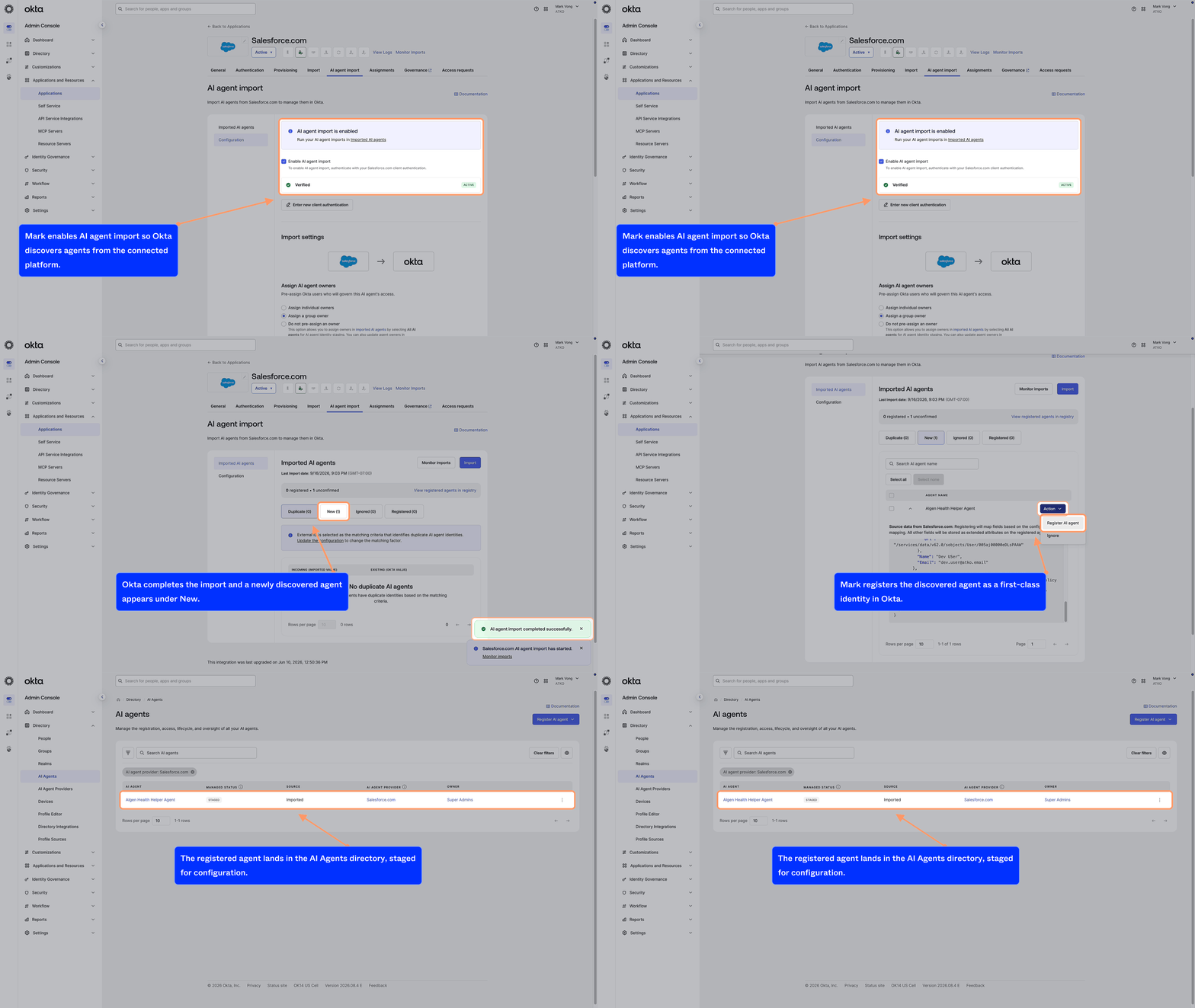
Okta for AI Agents for Okta Customer Identity helps organizations establish external-facing agents as first-class identities. Rather than relying on fragmented, application-specific controls, teams can:
- Register agents
- Assign ownership
- Manage lifecycle status
- Maintain a centralized view of approved agents
Demo: Establishing agent identity
Register an AI agent, assign ownership, and manage its identity and lifecycle in Okta for AI Agents.
Give agents only the authority they need
What can they do?
Authenticating an external user establishes who that person is. It does not automatically define what an AI agent acting on that user’s behalf should be able to access or do. An agent should not automatically inherit an external user’s full permissions. Instead, it should receive only the specific, policy-controlled authority required for the task it is approved to perform.
Scoped policy enforcement
For example, an agent helping a customer update an address may need access to profile information and an approved account-management workflow. It should not automatically gain access to payment methods, account-recovery settings, claims history, or unrelated systems. Without clear boundaries, convenience can become excessive access, and then you are one click away from a breach.
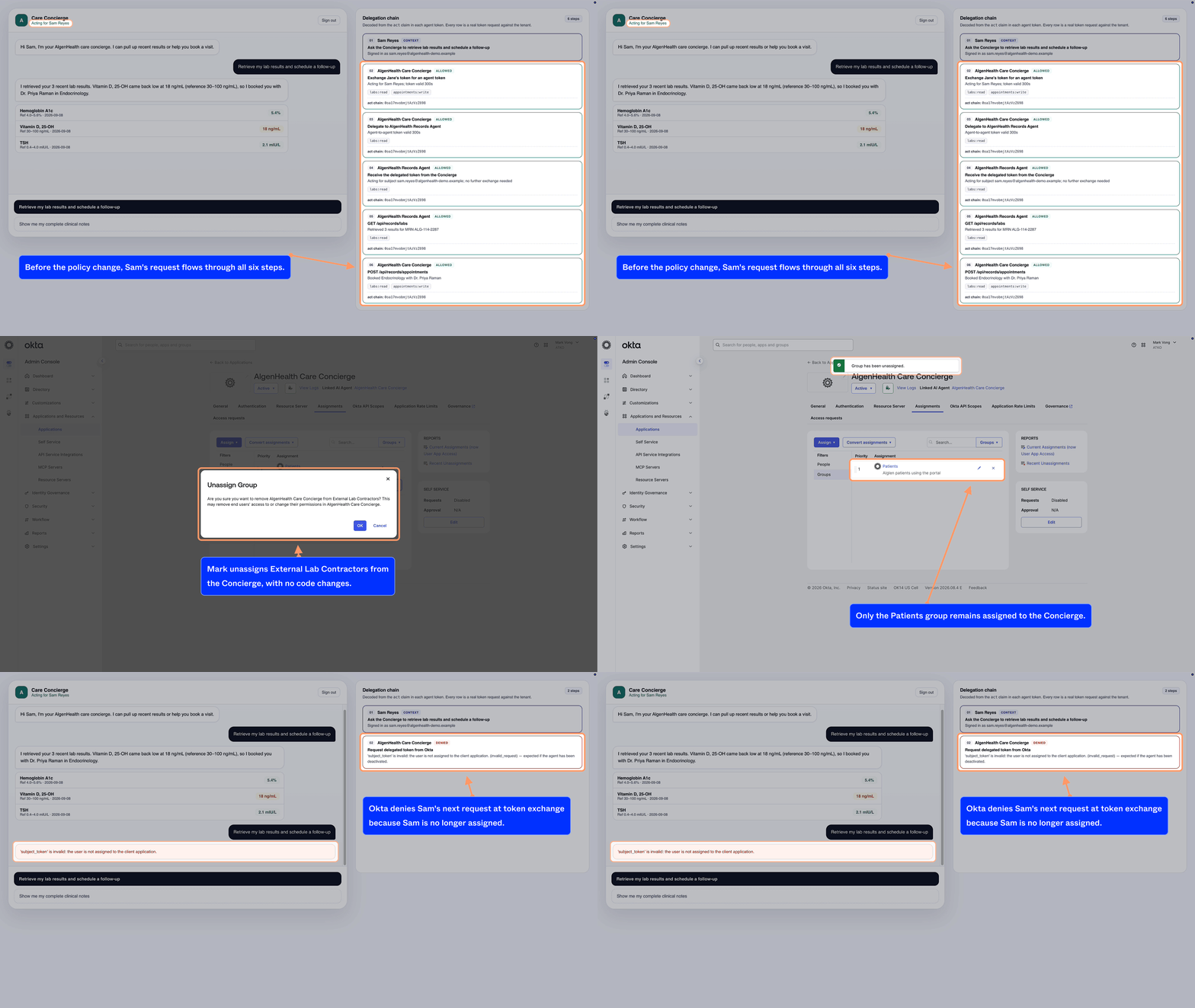
Okta for AI Agents for Okta Customer Identity helps organizations configure which authenticated users can invoke an agent and scope the resources and actions available to that agent for an approved interaction. This supports least-privilege access to the data, APIs, workflows, and actions needed for an approved interaction, without granting unrestricted or persistent access to underlying systems.
Context-preserved delegation
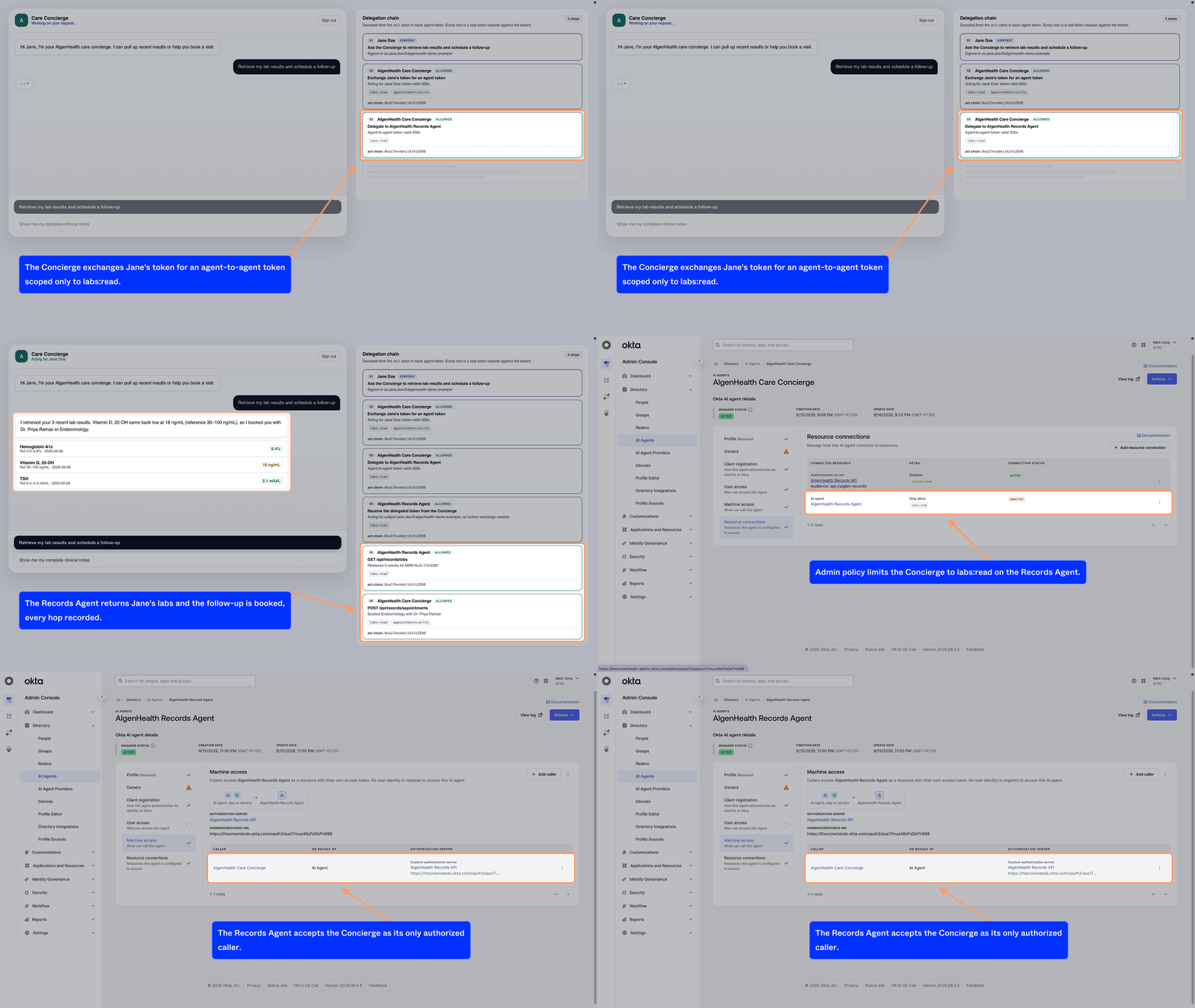
This is especially important in multi-agent workflows. A service agent may engage a specialized claims, fulfillment, or fraud-review agent to complete part of a task. As work moves between agents, the original external user’s authorization context should remain intact. Each agent should receive only the authority required for its specific role, rather than inheriting broad permissions from the initiating user or agent.
The result is safer automation, lower risk of unauthorized actions and data exposure, and smoother experiences that reduce unnecessary, repetitive consent prompts.
Demo: Multi-agent delegation
Authorization can be delegated across AI agents while preserving the customer context and maintaining control over what each agent can do.
Demo: Low-code access policy enforcement
Teams can apply and enforce policies that limit an agent to the actions and resources authorized for a customer interaction.
Maintain visibility and enforce controls as agents act
What are they doing?
As AI agents act on behalf of external users, organizations need a clear record of the actions they take—whether they update an account, access sensitive information, initiate a transaction, or trigger a downstream workflow. When a customer, auditor, or security team needs to investigate an interaction, they should be able to see which agent acted, what it accessed or attempted to do, and which external user authorized the interaction.
Okta for AI Agents for Okta Customer Identity treats agents as distinct identities and records agent activity. Teams can review agent authentication events, delegation grants, and resource-access activity to understand:
- Which agent performed the action
- Who the agent was acting on behalf of
- When the interaction occurred
- Which resource the agent accessed or attempted to access
Auditing and dispute resolution
This visibility helps teams investigate customer questions, resolve disputes, support audit and compliance requirements, and trace multi-agent workflows back to the original customer authorization. It also gives administrators the context they need to identify unexpected activity and determine whether an agent should remain active.
Contain agent risk while protecting trusted experiences
How do I respond?
When risk emerges, teams need a targeted response. Shutting down an entire customer or partner session can create unnecessary disruption, but allowing a risky agent to continue operating can expose sensitive systems, data, and business processes.
Targeted agent revocation
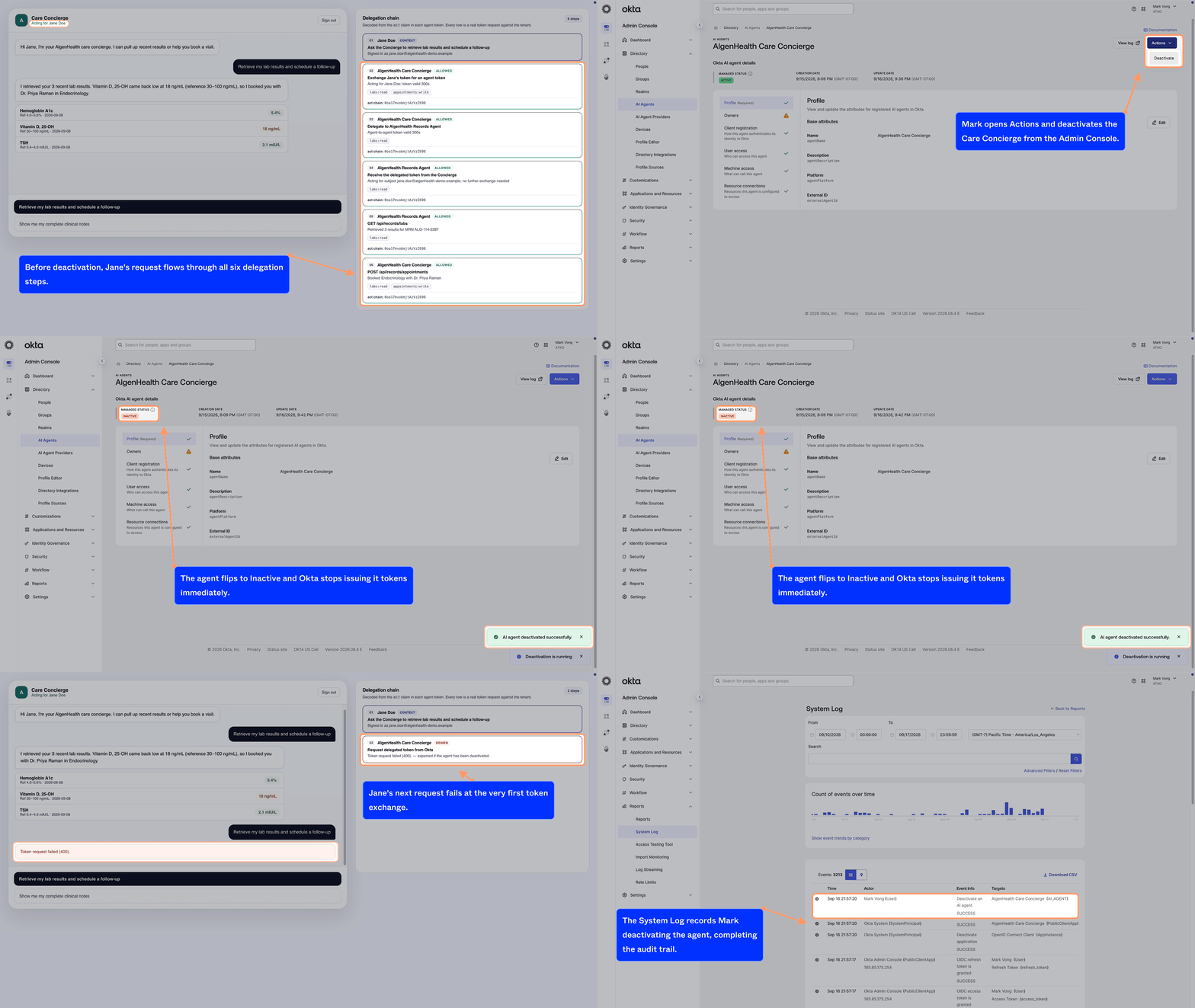
Okta for AI Agents for Okta Customer Identity helps teams rapidly deactivate a compromised, noncompliant, or retired agent and revoke its access when needed. Deactivation prevents the agent from obtaining new tokens for protected resources, preventing access to new resources while teams investigate and contain the risk. It does not terminate existing sessions, helping to avoid unnecessary disruption to the broader external user experience.
User experience continuity
Strong agent governance is not only a security and compliance requirement. It also helps organizations protect customer and partner trust, reduce the risk of disruptive or unauthorized actions, and support AI-enabled services that reflect the brand experience users expect.
Demo: Kill switch and the System Log
Teams can investigate agent activity in the Okta System Log and quickly revoke agent access when they need to contain risk.
Govern the next generation of external AI experiences
External-facing AI agents will increasingly participate in high-value moments: servicing customers, managing accounts, supporting business users and partners, accessing sensitive information, and completing transactions. Organizations should be able to innovate these experiences without losing control of who, or what, is acting in their environment.
Okta for AI Agents for Okta Customer Identity brings external-facing agents into a centralized identity layer, with clearer ownership, scoped authority, runtime controls, visibility, and rapid response. This helps organizations build AI experiences that are more secure, auditable, and worthy of customer and partner trust.
Ready to bring stronger identity controls to AI agents serving consumers, business customers, and partners? Talk to your Okta account team to explore your use case, or learn more about Okta for AI Agents.
Any features or services that are on the roadmap or available in beta, Early Access, or similar non-Generally Available release status may not be developed, released, or made Generally Available, or may have different features, functionalities, technologies, configurations, and/or documentation at the time of release. These materials are intended for general informational purposes only and are not intended to be legal, privacy, security, compliance, or business advice. ©2026 Okta, Inc. and/or its affiliates.


