


At Oktane® on the Road Singapore, one idea came up in almost every session. Organisations here are no longer asking whether to use AI. They are asking how to use it safely, and how to show their board and regulators that they are in control.
For those who could not join us, here is a short summary of what we discussed, along with some practical next steps.
Singapore has set clear guidelines
Swan Chin Yeo, Okta's® Head of Greater ASEAN, opened the afternoon by looking back at a busy year for AI governance in Singapore:
January: IMDA launched the Model AI Governance Framework for Agentic AI at the World Economic Forum in Davos1. It is widely described as the world's first framework for AI that can take actions on our behalf.
May: IMDA updated the framework with real case studies, and added guidance on risks from multi-agent systems and third-party agents.
October: MAS issued its Guidelines on AI Risk Management2. These set out what MAS expects from financial institutions using AI, including AI agents, with oversight sitting with the board and senior management.
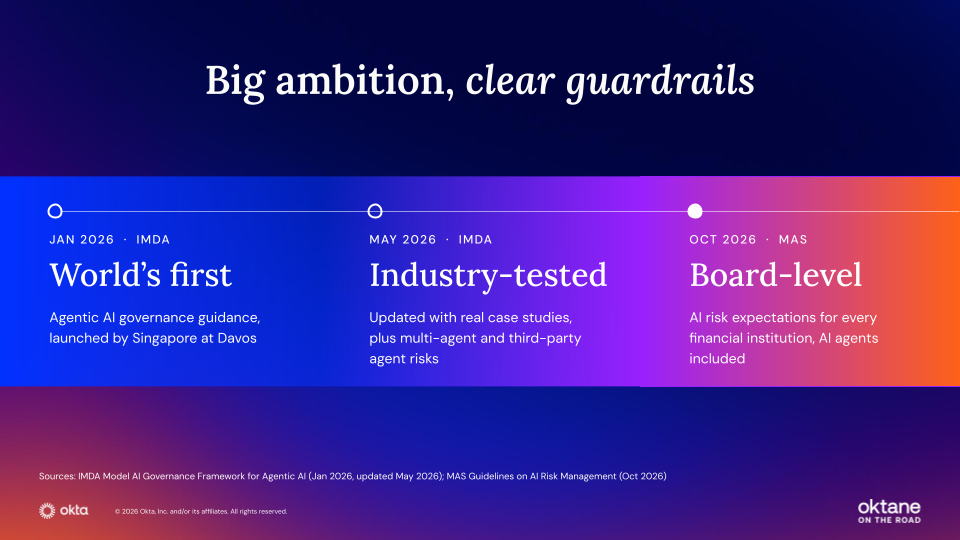
He summed it up as "big ambition, clear guardrails". In his view, this is a real strength for Singapore. When expectations are clear, organisations can plan with confidence.
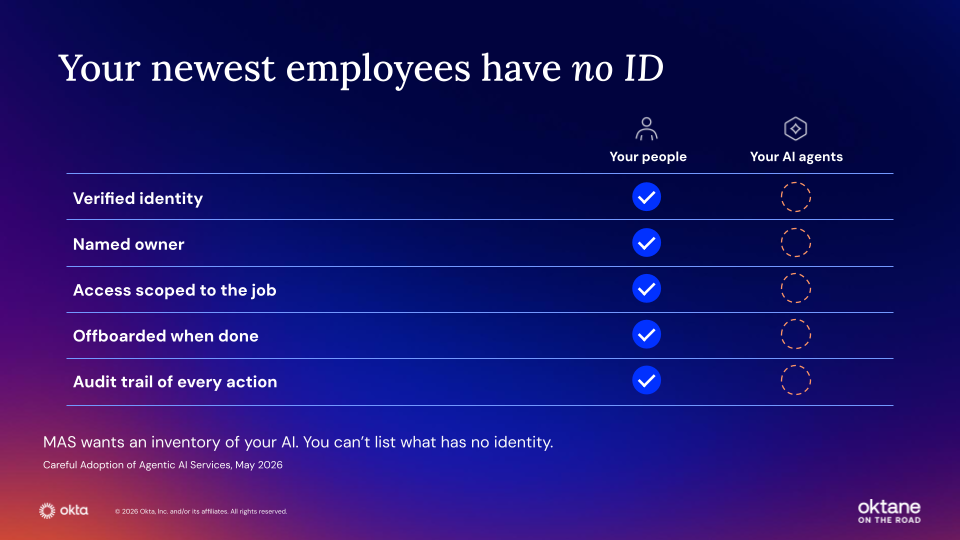
He then used a simple example. A new staff member who arrives with no staff pass, no manager and access to every system would not get past reception. AI agents need the same basics we give our people: a verified identity, a named owner, access that matches the job, offboarding when they leave, and a record of what they do. This matters because the MAS guidelines expect financial institutions to keep an inventory of their AI, with the governance expectations applying from October 2027. And you cannot list what has no identity.
Security and innovation do not have to compete
Mathew Graham, Chief Security Officer, APAC, built on this in the Okta keynote. Many organisations feel they must choose between locking agents down to reduce risk, or giving them the freedom to innovate. His view is that with the right visibility and control, you can have both.
He also made the point that no single company can secure AI agents alone. Agents connect to models, applications, data and security tools from many different providers, so the industry needs open standards and a shared approach. That is the thinking behind the Blueprint Alliance, which Okta formed with technology partners, systems integrators and industry advisors.
Foad Farrokhnia, VP of Channels and Alliances for APJ at Zscaler, joined Mathew on stage to talk about why this kind of partnership matters.
Moving from pilot to production
Stephanie Barnett, VP of Presales at Okta, hosted our partner panel with Steven Scheurmann (VP SENA, CrowdStrike), Foad Farrokhnia (VP, Partners & Alliances AP, Zscaler), Rishi Anand (Partner, PwC) and Gaurav Keerthi (CEO, StrongKeep). She framed the challenge clearly: organisations need to move fast to stay competitive, and move carefully to stay secure and compliant, at the same time.
The panel looked at what it takes to move AI from pilot to live use, how to keep agent access tightly limited, and what the IMDA and MAS guidance means in practice.
Practising what we share
In our Okta on Okta session, Ewan Thomas, Head of APJ Office of the Field CTO, shared how Okta runs its own platform first. AI agents are treated as a new kind of non-human identity, governed by the same principles as our people. One line stood out for me: when something goes wrong, "we don't want to burn down the house; we want to slam one door shut".
We also heard from our guest speaker Gaurav Keerthi, CEO of StrongKeep, our threat intelligence team on why phishing-resistant sign-in matters more as attacks speed up, Eric Lee, Cyber Leader, Deloitte Southeast Asia on the state of AI security, and a fireside chat with one of our B2B SaaS on preparing today’s workforce for an AI-driven enterprise
Four questions to start with
We shared four questions at the centre of the Blueprint. They are a good place to begin with your own team:
Where are our agents?
What can they do?
What are they doing?
How do we respond if something goes wrong?
If these are difficult to answer today, that is a useful place to start. Find more here - https://www.okta.com/en-sg/solutions/secure-ai/
Thank you to our speakers, sponsors, partners and everyone who joined us. We look forward to continuing the conversation. Talk to our Singapore team
Sources:
1IMDA Model AI Governance Framework for Agentic AI (v1.5, May 2026)
2MAS Guidelines on AI Risk Management (7 Oct 2026)
These materials are intended for general informational purposes only and are not intended to be legal, privacy, security, compliance, or business advice. © Okta, Inc. and its affiliates. 2026.


