





The age of AI is upon us, and at Okta, we’re embracing its potential to revolutionize productivity and innovation. As we roll out powerful AI tools to our employees, we’re seeing firsthand how they can enhance the way we work. At the same time, we recognize that a critical part of deploying AI responsibly is understanding and addressing its environmental impact.
That’s why we’re excited to share a behind-the-scenes look at Okta’s Sustainable AI program and our work to develop a model for measuring the energy consumption and carbon emissions from our use of AI, in partnership with IT Climate Ed. We want to be transparent about our journey, our methodology, and what we’re learning along the way.
Our Sustainable AI Strategy
Our approach to Sustainable AI is an extension of our broader climate strategy, centered on four key pillars:
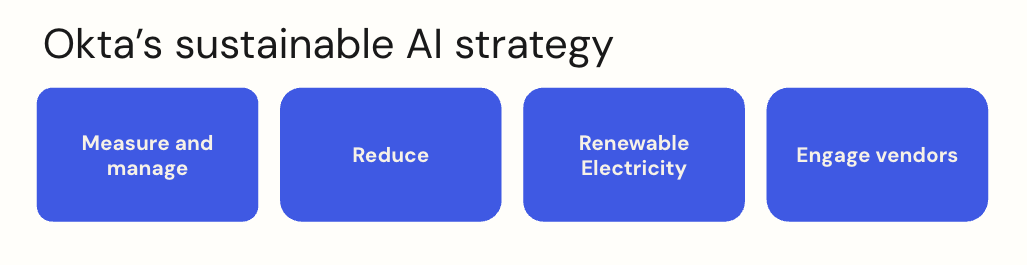
- Measure and Manage: Understanding our AI-related environmental footprint.
- Reduce: Using AI efficiently and choosing the most appropriate models for the job.
- Renewable Electricity: Expanding our 100% renewable electricity program to cover our top AI enterprise tools.
- Engage Vendors: Partnering with our AI vendors to promote sustainability across the industry.
This post focuses on the foundational first step: Measure and Manage. After all, you can't improve what you don't measure.
An Interim Methodology in a Rapidly Evolving Field
One of the biggest challenges in assessing AI's environmental impact is the lack of a single, industry-wide standard for measuring and reporting the energy and carbon emissions of AI tools and models. The other challenge is the lack of disclosure and tools from the AI industry on reporting their customer’s emissions. In this rapidly evolving landscape, we’ve developed an interim methodology to help us navigate this new terrain. This approach is built on publicly available research and data, allowing us to estimate the environmental impact of our AI usage today while we continue to advocate for greater transparency and standardization from our partners and the industry at large.
We first identify a use case, such as AI-assisted code generation. Then we apply a three-step process as follows:
- Measure Usage Activity: We begin by looking at our own usage data, this includes metrics like the number of lines of code generated and the volume of chat interactions.
- Convert Activity to Energy Consumption: Next, we translate this usage activity into energy consumption. This is a complex step that involves converting lines of code and chat messages into "tokens" (the units of text that AI models process), then using energy profiles for different AI models to estimate token energy density. We also add in the model training share that can be attributed to Okta.
- Calculate Carbon Emissions: Finally, we calculate the carbon footprint based on the estimated energy consumption and the data center locations. We consider employee distribution to map cloud data center regions and associated carbon intensity for inference. For model training, we estimate the data center location based on the AI vendor and the AI model. This includes the operational emissions from the electricity used to power the AI models, the embodied emissions associated with manufacturing the server hardware, as well as training emissions attributed to Okta.
We believe this methodology, although reliant on a number of assumptions and subject to uncertainties, is a step forward in helping us to better understand our impact and providing a baseline from which we can improve. It spans from both limited specific model architecture disclosure for closed models, as well as data center infrastructure running these models. We will be using this information for internal purposes and will not be integrating it into our greenhouse gas inventory. This will serve as a baseline understanding of our AI environmental footprint, allowing us to identify ways to invest in decarbonization.
The Path to Sustainable AI
This is just the beginning of our journey. Our next steps include:
- Updating our baseline: We will continue to track our AI-related emissions to monitor trends over time.
- Optimizing for Efficiency: We continue to encourage our employees to use AI more efficiently by choosing the most appropriate and the least energy-intensive models for their needs, and prompting efficiently.
- Promoting Transparency: We will continue to share our progress with our partners and the broader public, and advocate for greater transparency from our AI vendors and the industry as a whole.
We are committed to harnessing the power of AI to drive our business forward while upholding our commitment to sustainability. By taking a proactive and transparent approach to measuring and managing our AI energy footprint, we aim to identify ways to continue Okta’s environmental impact work. Learn more about our Sustainable AI strategy in Okta's 2025 sustainability update.


