
Nonprofits at Work 2026: The new frontline of the agentic era

About the Author

Shameek Bose

VP of Global Impact

Shameek Bose, Okta's VP of Global Impact, brings more than 20 years of experience at the intersection of responsible business, technology, transformation, and strategic growth. Throughout his career, Shameek has partnered with the world’s largest organizations to demonstrate that impact and growth are not competing priorities, but rather the same agenda.

At Okta, Shameek leads Okta for Good, overseeing social impact, sustainability and responsible tech, and the nonprofit industry practice. He views Okta for Good not as a standalone mission, but as a strategic platform for deepening customer trust, expanding market reach into the nonprofit and public sector, and demonstrating that responsible business and commercial growth reinforce each other.

Most recently, Shameek served as Global Lead for Responsible Business & Global Impact at FleishmanHillard, where he built and scaled a 72-person global practice. He achieved growth by helping Fortune 500 companies connect ESG and sustainability strategy to revenue, reputation, and long-term competitive advantage. Prior to that, at Accenture, he advised Fortune 500 boards and C-suite leaders on governance, sustainability, and responsible business transformation, embedding impact into large scale technology implementations. During seven years at the World Economic Forum, he was selected as a Global Leadership Fellow and engaged North America’s top CEOs on the business implications of AI, climate, and geopolitical disruption.

Shameek's career has also included leading partnership strategy at amfAR, The Foundation for AIDS Research, and founding Bose Consulting, a boutique firm delivering corporate relations and transformation strategies for leading nonprofits and social sector organizations. He raised over $100M for the UN Sustainable Development Goals through his work.

He holds a Master of Public Administration from Columbia University’s School of International & Public Affairs and a Bachelor of Arts in Economics from Rutgers University. He serves on the National Board of Directors at GLAAD

20 5월 2026 Time to read: ~

The nonprofit sector is a vital part of the global economy, managing high-stakes data like donor records, refugee data, and sensitive government grants. This growing digital footprint, and a lack of funding for cybersecurity, has made these organizations increasingly vulnerable to security threats. 

Okta’s Nonprofits at Work 2026 report reveals a difficult reality: While AI offers ways for nonprofits to serve their communities as budgets shrink, it puts this already heavily targeted and under-funded sector in an even more precarious position. The data suggests that for many mission-driven organizations, the path to a high-tech future is currently blocked by a significant security gap.

The 78% attack velocity

The most sobering finding in this year’s report is an astonishing surge in malicious activity. Two years ago, the ratio of threats to authentications in the nonprofit sector was just 2.6%. Last year, it rose to 18%. This year, that figure skyrocketed to 78%.

Nearly four out of five login attempts at nonprofits are now fraudulent, making it the most-attacked industry in our dataset and surpassing historically "hard" targets such as finance and energy. This exponential rise in threat activity suggests that attackers see the nonprofit sector as a target-rich and less-defended environment. Because these organizations manage sensitive data for donors and vulnerable populations, identity security has become a mission-critical imperative.
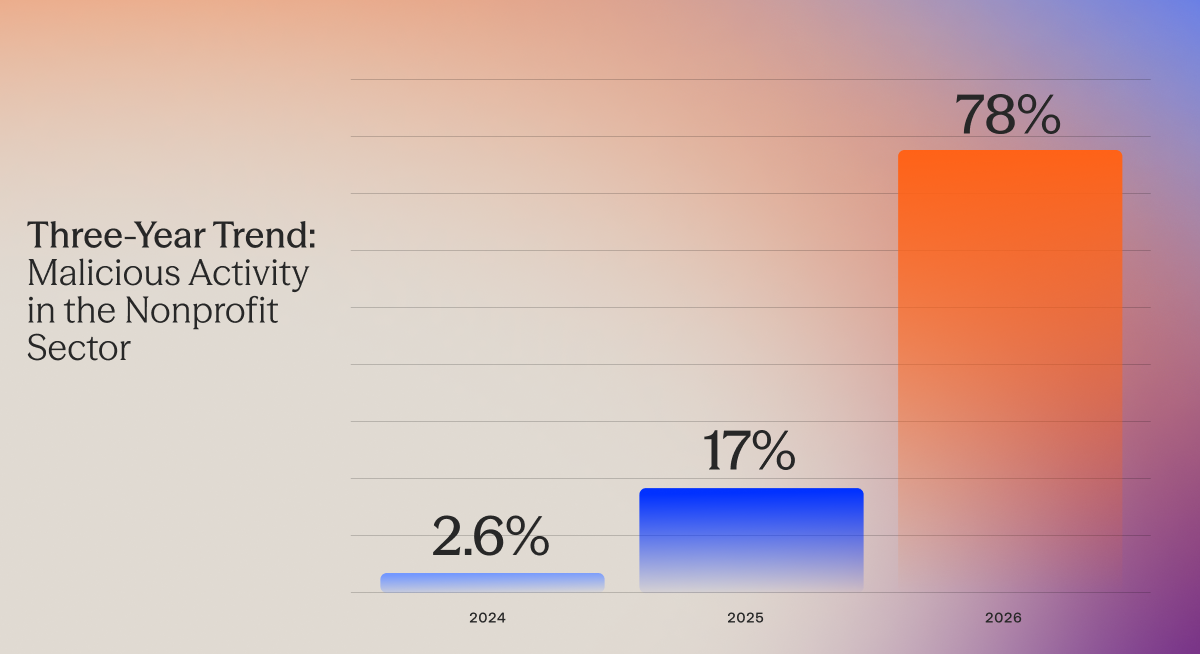
Three-year trend: Malicious activity in the nonprofit sector

The governance vacuum and shadow AI

Used as a "financial force multiplier," AI could help nonprofits handle growing workloads with shrinking resources. The report found that 80% of larger nonprofits (more than 200 employees) are already deploying or piloting autonomous AI agents.

However, adoption is outstripping oversight. Three out of four (76%) nonprofits lack a formal AI strategy, and 58% have no restrictions in place for the use of AI tools. This creates a "shadow AI" nightmare. Staff are using free tools like ChatGPT to automate individual workflows, but these apps often sit outside the protection of Single Sign-On (SSO) and Multi-Factor Authentication (MFA), leaving sensitive data exposed.

Volunteers organizing donations at community center

The automation gap

Perhaps the most critical barrier to nonprofit security is the lack of foundational automation. Nonprofits currently rank last among all 16 industries for automated lifecycle management (LCM) — the process of automatically onboarding, offboarding, and managing user access.

In an era where attackers move at machine speed, many nonprofits are still fighting back with manual, human-speed processes. Without automated governance, the impending proliferation of non-human identities (NHIs) and AI agents will inevitably create an unmanageable attack surface. There is good news: While the gap is significant, some nonprofits are making steady progress. The sector’s LCM-using customer base is growing at 5% per year, ranking it No. 9 for year-over-year growth across all industries.

Image Image

Measure your AI readiness in 2 minutes

See where identity, access, and agent control break down in production

The path forward: Identity as a bedrock

Despite these challenges, there is a clear path toward resilience. Nonprofits are rapidly adopting phishing-resistant authentication, with Okta FastPass passwordless logins growing by 98% year-over-year. 

To safely navigate the agentic age, nonprofit leaders must move beyond manual security. Scaling impact in 2026 requires a bedrock of strong identity security: continuous authentication, automated lifecycle management, and robust governance for both human and machine identities.
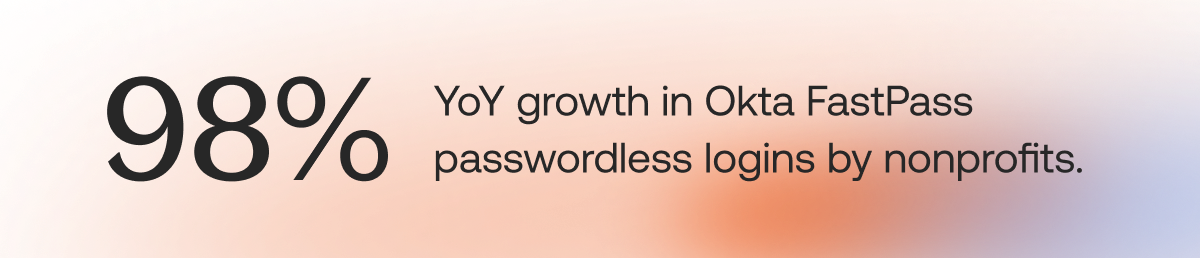
98% YoY growth in passwordless logins

Is your organization ready for the speed of AI?

Download the full Okta Nonprofits at Work 2026 report to explore the data, and take our AI Readiness Assessment to uncover your blind spots and understand your AI identity readiness in minutes.

About the Author

Shameek Bose

VP of Global Impact

Shameek Bose, Okta's VP of Global Impact, brings more than 20 years of experience at the intersection of responsible business, technology, transformation, and strategic growth. Throughout his career, Shameek has partnered with the world’s largest organizations to demonstrate that impact and growth are not competing priorities, but rather the same agenda.

At Okta, Shameek leads Okta for Good, overseeing social impact, sustainability and responsible tech, and the nonprofit industry practice. He views Okta for Good not as a standalone mission, but as a strategic platform for deepening customer trust, expanding market reach into the nonprofit and public sector, and demonstrating that responsible business and commercial growth reinforce each other.

Most recently, Shameek served as Global Lead for Responsible Business & Global Impact at FleishmanHillard, where he built and scaled a 72-person global practice. He achieved growth by helping Fortune 500 companies connect ESG and sustainability strategy to revenue, reputation, and long-term competitive advantage. Prior to that, at Accenture, he advised Fortune 500 boards and C-suite leaders on governance, sustainability, and responsible business transformation, embedding impact into large scale technology implementations. During seven years at the World Economic Forum, he was selected as a Global Leadership Fellow and engaged North America’s top CEOs on the business implications of AI, climate, and geopolitical disruption.

Shameek's career has also included leading partnership strategy at amfAR, The Foundation for AIDS Research, and founding Bose Consulting, a boutique firm delivering corporate relations and transformation strategies for leading nonprofits and social sector organizations. He raised over $100M for the UN Sustainable Development Goals through his work.

He holds a Master of Public Administration from Columbia University’s School of International & Public Affairs and a Bachelor of Arts in Economics from Rutgers University. He serves on the National Board of Directors at GLAAD

Get our Identity newsletter

Okta newsletter image