

An early lesson in cryptographic trust, and why it matters for AI agents today.
I’ve been spending a lot of time thinking about how we establish trust in AI agents. How do we know who created an agent, who it’s acting on behalf of, and what authority it actually has? More importantly, how can one system trust those assertions across organizational boundaries?
It reminded me of a problem I worked on nearly 20 years ago: securing airline boarding passes.
In 2007, I was Director of Strategic Innovation at the Transportation Security Administration (TSA). Airlines were moving aggressively toward electronic boarding passes that passengers could print at home or display on their phones. It was a great innovation, but it also introduced a security problem.
How could TSA know that a boarding pass was actually issued by an airline, rather than fabricated or modified by a passenger?
Barcodes were becoming the standard way to encode boarding-pass information, but a barcode isn’t inherently trustworthy. It’s just data represented in a machine-readable format. Anyone with the right software could generate one that looked legitimate.
The obvious solution was to have TSA validate each boarding pass against the airline’s reservation system. But connecting thousands of security checkpoints to hundreds of airlines' reservation systems to validate passes was too costly, complex, and prone to system downtime.
We needed a way to authenticate boarding passes without requiring the airlines to participate in every verification.
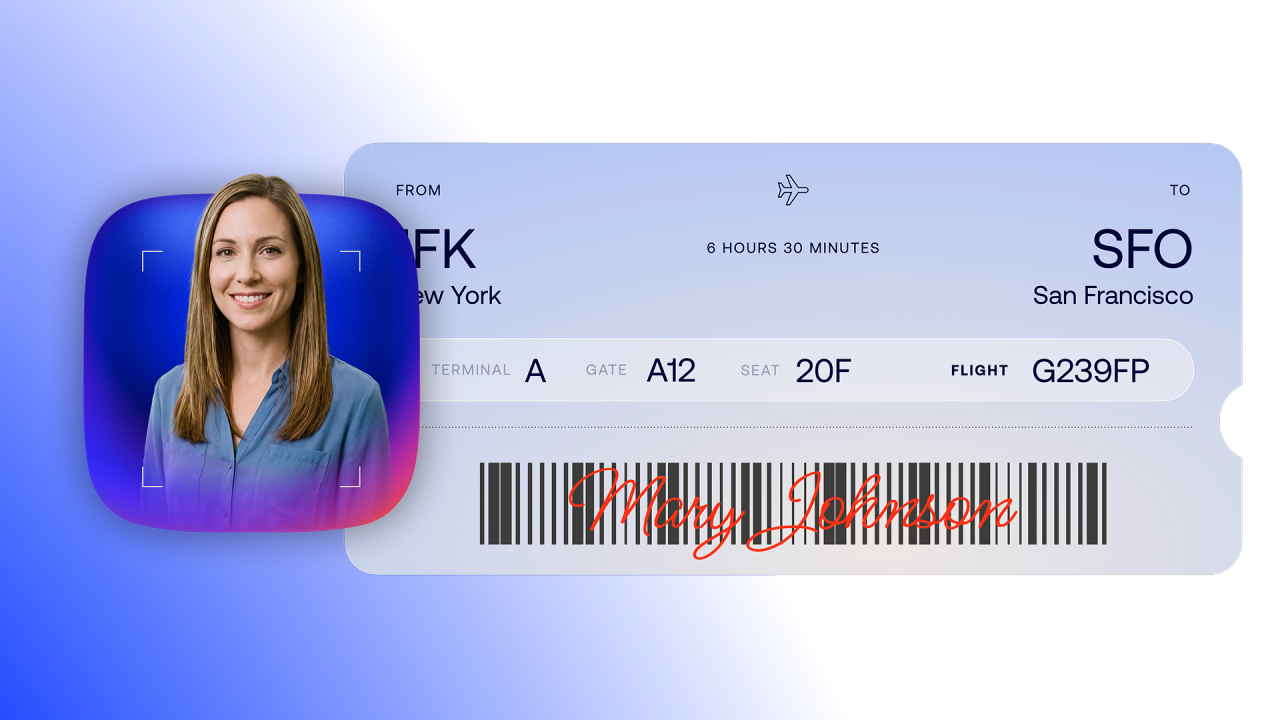
Putting the trust in the barcode
The solution we developed was to digitally sign the boarding-pass data and embed the cryptographic signature directly into the two-dimensional barcode.
An airline would use its private key to sign the boarding-pass data when issuing it. At the checkpoint, TSA could scan the barcode, extract the data and signature, and verify the signature using the airline’s public key.
Because verification could happen offline, TSA didn’t need a live connection to the airline, and the airline didn’t need to expose its reservation system. We had solved a fundamental trust problem by separating the issuance of a credential from its verification.
What made the work particularly meaningful was that it didn’t stop with the TSA. In 2008, the International Air Transport Association amended its standards for mobile boarding passes to include digital signatures. We had applied existing technologies to a cross-organizational trust problem in a way that could be standardized across the global airline industry.
The same idea, a decade before verifiable credentials
In 2019, the World Wide Web Consortium (W3C) published the first formal verifiable credentials standard. With a verifiable credential, the issuer makes cryptographically verifiable claims about a subject, which a holder presents to a third party. The verifier can validate the credential’s authenticity without necessarily contacting the issuer.
Modern implementations have new capabilities, but the underlying model is remarkably similar to what we implemented in 2007.
The airline was the issuer. The passenger held the credential. TSA was the verifier. Both use cases establish trust across organizational boundaries without creating unnecessary dependencies.
We were implementing many of the core architectural ideas before the W3C standardized verifiable credentials. And they are becoming increasingly relevant again.
What does this have to do with AI agents?
Quite a bit. We’re entering a world where AI agents will routinely interact with external applications and services, invoking other agents and creating chains of delegated authority that cross application and organizational boundaries.
This raises familiar trust questions. If Company A’s agent interacts with Company B’s application, how does Company B know who the agent belongs to, who it represents, or if it is authorized to act?
You could solve some of this through centralized lookups, API calls, or tightly coupled integrations. But those approaches don’t scale particularly well when agents are interacting dynamically across hundreds of applications and services.
Alternatively, trusted authorities can issue cryptographically signed assertions about an agent's identity and authority. Those assertions could travel with the agent and be independently verified by other systems—the same principle we applied to boarding passes.
Of course, authenticating an agent is only part of the problem. Verifying a credential is not the same as authorizing an action. Just as a valid boarding pass didn't automatically clear someone through security, verifying an agent's identity doesn't mean it should be allowed to export a customer database or transfer money.
For agents, that distinction becomes especially important because their authority is often delegated, contextual, and temporary. An agent might have permission to retrieve a document but not share it externally. It might be authorized to perform an action on behalf of one user but not another. And those permissions can change while the agent is operating.
Cryptographically signed credentials can establish provenance, integrity, and potentially delegated authority. They don’t eliminate the need for dynamic authorization, revocation, or policy enforcement.
This is one of the challenges we’re focused on at Okta as we think about securing AI agents. The goal isn’t simply to give agents identities. It’s to establish a trusted foundation for determining which agents are operating, whose authority they’re exercising, and what actions they should be permitted to take.
That requires connecting identity, delegation, and authorization in ways that work across organizational and application boundaries.

Old problems, new technology
In security, we tend to rediscover old problems whenever a new technology comes along.
AI agents introduce plenty of genuinely new challenges, but the underlying identity and trust problems are surprisingly familiar.
How do you establish that an assertion came from a trusted source? How do you make that trust portable? How do you verify it independently? And how do you distinguish between trusting an identity and authorizing an action?
We were asking versions of those questions at TSA in 2007. We’re asking them again today, just in a very different context.
The specific technologies will continue to evolve. But I suspect the most successful approaches will rely on the same core principles we used nearly 20 years ago: cryptographic trust, interoperability, independent verification, and a clear distinction between authentication and authorization.
It’s funny to think that some of the problems we’re trying to solve for autonomous AI agents have roots in something as mundane as an airline boarding pass.
Then again, security has always been less about the technology itself and more about figuring out who or what you can trust, and why.
Ely Kahn is Chief Product Officer at Okta and previously served as Director of Strategic Innovation at the Transportation Security Administration.