




Executive summary: Meeting CMMC 2.0 AU controls with identity telemetry
Okta helps defense contractors fulfill CMMC 2.0 Audit and Accountability (AU) controls by transforming identity events into immutable, auditor-verifiable records. By binding every system interaction to a unique, MFA-verified credential and streaming continuous telemetry to FedRAMP-authorized SIEM platforms, organizations can satisfy baseline log retention (AU.L1-3.3.1), individual non-repudiation (AU.L2-3.3.2), and automated log analysis (AU.L3-3.3.5).
This is the second blog in our three-part series on the role of identity in the Cybersecurity Maturity Model (CMMC) 2.0 framework. If you missed it, you can read Part 1: How Okta can help organizations meet CMMC 2.0 Identification and Authentication requirements.
Why the Audit and Accountability (AU) domain matters in CMMC 2.0
Verifying user identities (IA) and gating application access (AC) represent only part of the compliance puzzle. Under the CMMC 2.0 framework, you must actively demonstrate that your security controls operate as designed. The Audit and Accountability (AU) domain serves as your continuous, tamper-resistant system of record.
When an incident occurs or a Certified Third-Party Assessment Organization (C3PAO) auditor arrives, your organization must answer three key questions:
- Who accessed or attempted to access the environment?
- When did the transaction take place?
- What specific data, application, or administrative configuration did they access or modify?
The AU domain consists of critical, high-value “big rock” controls, each individually weighted at 5 points. Failing to satisfy a single five-point control results in an immediate assessment failure. This post details how Okta’s centralized identity logging meets these requirements across CMMC Levels 1, 2, and 3, transforming manual log coordination into automated, auditor-ready evidence.
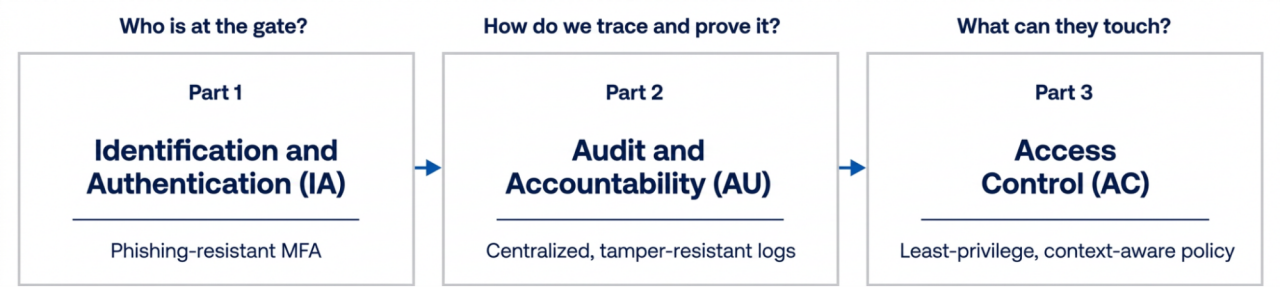 The three-part series. This post covers Part 2: Audit and Accountability.
How does Okta meet CMMC Level 1 audit log retention?
Level 1 focuses on basic cyber hygiene. Even at this initial tier, organizations handling federal contract information (FCI) must establish baseline system tracking to ensure teams can investigate unauthorized activity.
| Key Level 1 control | Requirement | Correlated NIST SP 800-53 control |
|---|---|---|
| AU.L1-3.3.1: Create and Retain System Audit Logs | Create and retain system audit logs and records to the extent needed to enable the monitoring, analysis, investigation, and reporting of unlawful or unauthorized system activity. | AU-2: Event Logging |
Technical implementation with Okta
- The centralized Okta System Log: Okta automatically records a comprehensive, read-only audit log of all system, administrative, and user-initiated events. This includes sign-in successes, sign-in failures, credential resets, and policy modifications.
- Unified identity pipeline: Instead of logging in to dozens of siloed applications to harvest fragmented activity logs, Okta routes all federated application traffic through a single pipeline. This aggregates downstream authentication events into a centralized stream, ensuring consistent monitoring across the enterprise.
- Long-term retention and streaming: While the Okta System Log interface provides immediate search capabilities, federal regulations require multi-year retention. Okta integrates natively with secure storage (such as AWS S3) and Security Information and Event Management (SIEM) systems (for example, Splunk and QRadar) through the Okta Event API, guaranteeing compliant log preservation.
Auditor evidence package (C3PAO artifacts)
- Show the live log viewer: Navigate through the Okta System Log interface to demonstrate real-time event tracking, showcasing successful logins, policy updates, and denied attempts.
- Verify SIEM integration: Show active API connectors streaming identity telemetry from Okta directly into your centralized SIEM dashboard.
- Review retention rules: Provide documented configurations in AWS or your SIEM demonstrating that logs are locked and cannot be deleted prematurely by administrators.
How does Okta enforce unique user accountability for CMMC Level 2?
For contractors managing controlled unclassified information (CUI), CMMC Level 2 demands strict individual accountability. Assessors must be able to trace every digital action back to a specific, living human being.
| Key Level 2 control | Requirement | Correlated NIST SP 800-53 control |
|---|---|---|
| AU.L2-3.3.2: Ensure User Accountability | Ensure that the actions of individual system users can be uniquely traced to those users so they can be held accountable for their actions. | AU-3: Content of Audit Records |
Technical implementation with Okta
- Elimination of shared accounts: Okta Universal Directory establishes a unique, immutable identity profile for every employee, contractor, and administrator.
- Federated identity injection: When a user accesses an application containing CUI through Okta Single Sign-On (SSO), Okta injects their unique identity attributes (such as email or unique user ID) into the secure Security Assertion Markup Language (SAML) or OpenID Connect (OIDC) assertion. The target application’s local audit logs must register the individual’s specific profile, preventing users from hiding behind generic local application service accounts.
- Individualized administrative roles: Okta prevents the sharing of administrative credentials. Role-based access control (RBAC) in Okta assigns specific, granular administrative privileges directly to individual profiles, each requiring a separate, phishing-resistant multi-factor authentication (MFA) challenge.
Auditor evidence package (C3PAO artifacts)
- Demonstrate Universal Directory mapping: Show how your Active Directory, LDAP, or HR directories sync directly to Okta, proving that every active credential maps back to a verified, single human being.
- Execute an end-to-end audit trace: Pick a random administrative change within a critical tool (such as AWS GovCloud or Microsoft 365) and trace the action’s session ID back through the Okta System Log to find the exact username, IP address, device posture, and MFA method used.
- Verify SSO configurations: Show configuration pages for CUI-holding apps to demonstrate that local backdoor password logins are completely disabled, forcing all access to go through audited Okta pathways.
How does Okta automate continuous audit log analysis for CMMC Level 3?
CMMC Level 3 is reserved for organizations working on critical Department of Defense programs targetable by advanced persistent threats (APTs). At this stage, static, retrospective log reviews are insufficient; you must prove your logging system is dynamic and capable of driving automated defense.
| Key Level 3 control | Requirement | Correlated NIST SP 800-53 control |
|---|---|---|
| AU.L3-3.3.5: Review and Update Logged Events | Review and update logged events on an ongoing basis to ensure the continued effectiveness of the controls. | U-6: Audit Record Review, Analysis, and Reporting |
Technical implementation with Okta
- Okta Identity Threat Protection: Powered by continuous session evaluation, Okta Identity Threat Protection acts as an automated, real-time log analyzer. It continuously monitors security telemetry and logs across your entire identity ecosystem.
- Shared Signals Framework orchestration: If a connected security tool—such as a CrowdStrike endpoint detection and response (EDR) agent on a laptop or a Zscaler cloud access security broker (CASB) gateway—logs a high-risk event, it broadcasts that security signal to Okta in real time. Okta ingests the log, dynamically recalculates the user’s risk score, and automatically triggers remediation.
- Automated security playbooks: Using Okta Workflows, organizations can build zero-touch compliance playbooks. If Okta logs a high-severity alert (for example, an impossible travel sign-in), Workflows can automatically quarantine the user in the directory, suspend access to active applications, and open an incident ticket in ServiceNow or Jira.
Auditor evidence package (C3PAO artifacts)
- Show the Identity Threat Protection console: Walk the assessor through the Okta Identity Threat Protection dashboard, showing how threat telemetry from your endpoint, network, and identity logs are correlated.
- Conduct a live threat simulation: Induce an alert on a test machine (such as triggering a simulated malware alert in your endpoint agent). Demonstrate how Okta immediately ingests that log signal and executes Universal Logout to terminate active cloud sessions.
- Present workflow execution logs. Provide the auditor with execution logs from Okta Workflows illustrating how identity alerts systematically generate tickets and trigger automated administrative lockouts.
CMMC 2.0 AU domain and identity mapping summary
| CMMC Level | Control ID | Compliance objective | Okta technical capability | Primary audit artifact |
|---|---|---|---|---|
| Level 1 | AU.L1-3.3.1 | Centralize and retain system access logs | Okta System Log and event streaming API | S3/SIEM integration configurations with SSO |
| Level 2 | AU.L2-3.3.2 | Trace every digital action to a unique user | Universal Directory and SAML/OIDC assertion injection | Directory sync map and end-to-end admin session traceback |
| Level 3 | AU.L3-3.3.5 | Analyze and act on security logs dynamically | Okta Identity Threat Protection and Okta Workflows | Shared Signals Framework integration and automated Universal Logout |
The audit blueprint: Connecting the dots
A successful CMMC assessment relies on a coherent identity story. Across this series, we have established the essential progression:
| Question | Where it is addressed |
|---|---|
| Who is at the gate? | Part 1, Identification and Authentication: Phishing-resistant MFA |
| How do we trace them? | Part 2, Audit and Accountability: Centralized, tamper-resistant log pipelines |
| How do we restrict them? | Part 3, Access Control: Dynamic, context-aware boundaries |
By centralizing your security telemetry in Okta for Government, you can turn what used to be weeks of manual log harvesting and audit preparation into a unified, downloadable body of evidence.
Next up
Stay tuned for Part 3: Access Control (AC), where we explore how to dynamically enforce least-privilege remote boundaries and prevent lateral threat movement.
Preparing for a CMMC 2.0 assessment? Contact our federal security architects to align your identity infrastructure with federal standards.
Dive deeper into identity-first compliance strategy: Download our CMMC Discovery Guide to learn key best practices, avoid common pitfalls across critical domains, and review Okta’s full CMMC 2.0 functional mapping.


