




Key takeaways: Extended Okta for AI Agents governance capabilities
- Eliminate internal credential sprawl: Register internal MCP servers as Okta OAuth clients to replace static API keys with short-lived, task-scoped tokens tied to the requesting user.
- Govern third-party MCP tools centrally: Extend Cross App Access—an open standard built on OAuth ID-JAG—to enforce central IT policies across external MCP servers.
What’s new: Extended MCP governance for more visibility and control
Okta for AI Agents is extending Model Context Protocol (MCP) governance in two ways, enabling IT teams to move AI agents into production across downstream enterprise systems and third-party MCP servers while maintaining visibility and control over every connection.
This release enables teams to:
- Limit the blast radius and pass compliance audits as internal MCP servers access downstream systems. Okta for AI Agents issues short-lived, scoped tokens for each connection between an internal MCP server and a downstream enterprise system. Teams can replace shared credentials and tie every action back to the requesting user and agent.
- Prevent shadow AI data leaks by bringing third-party MCP connections under governance. Cross App Access (XAA) is an open standard that lets teams manage how AI agents authenticate with other tools through central Okta policies, rather than through separate user consent prompts. Now, XAA extends centralized policy enforcement to external XAA-supported MCP servers, so teams can maintain central control over external MCPs running their own authorization servers.
Why securing only the first hop in an MCP workflow is a security risk
Securing the first hop between an AI agent and an internal MCP server is only the starting point. In production, agents may have to reach the downstream enterprise systems and third-party SaaS tools where sensitive data lives. When security controls stop at the first hop, IT teams cannot see or govern what the agent touches next, nor can they prove who accessed sensitive records.
For example, a single marketing prompt might trigger an internal orchestrator that calls Salesforce and Marketo, while also connecting to a third-party vendor's MCP server that runs its own authorization server.
Once an agent moves deeper into internal systems or outward to third-party tools, security leaders face two major risk and compliance blind spots that keep AI projects stuck in pilot:
- Uncontained blast radius and broken audit trails behind internal MCP servers: Internal MCP servers often rely on static API keys or shared service accounts to reach downstream enterprise systems. If a prompt injection compromises the workflow, the agent inherits overprivileged, standing access to core systems, and compliance teams cannot prove which human user initiated the change.
- Unmonitored shadow AI exposure across external MCP servers: Connecting to third-party MCP servers has meant relying on vendor-run authorization servers and scattered user consent screens. Security teams cannot restrict what third-party tools an agent can touch or pull a single kill switch if a vendor connection is compromised.
In both cases, security and IT teams hit the same wall: They cannot prove compliance across the full workflow or contain the risk of an overprivileged agent, forcing them to slow down AI agent production rollouts.
That changes today. Okta for AI Agents already secures the first hop between an agent and an internal MCP server. Now, that governance extends across downstream and external connections to unlock high-velocity AI adoption without the compliance exposure.
- Limit internal blast radius and pass compliance audits: Admins can now restrict agents to least-privilege access and tie every backend action to a human user by registering internal MCP servers as OAuth clients in Okta and exchanging tokens on each downstream hop. Every call to an enterprise system uses a short-lived, scoped token to unlock provable compliance across multistep internal workflows.
- Prevent third-party shadow AI data leaks: Admins can now govern third-party MCP connections by extending XAA to external XAA-supported MCP servers. This enables IT teams to unlock third-party AI productivity without the risk of shadow AI.
The result: Every hop along an agent's path is now scoped to the task, audited, and tied back to the person who made the request. Security and IT leaders do not have to choose between shipping AI agents fast and keeping enterprise data safe. Their teams can connect AI agents to internal and external tools with least-privilege controls and auditability to unlock faster AI ROI in production.
An agentic security framework
These capabilities map directly to the Blueprint Alliance's architectural blueprint for the secure agentic enterprise, which frames AI agent security around four questions. This release addresses the middle two questions:
- What can my agents do? This release helps you contain the blast radius of compromised prompts or overprivileged agents through initial setup and runtime constraints, preventing unauthorized access to backend systems.
- What are they doing? Now you can preserve human accountability with audit trails at every hop, unlocking frictionless compliance audits and regulated production rollouts.
Why identity is the foundation
Moving AI agents from pilot into production comes down to answering two questions for your board and auditors: Which human started the request, and what was the agent authorized to do? Those answers live in the identity layer: the user record, the sign-in policy, and the token exchange that carries that user's identity from one hop to the next.
Whether agents call MCP servers directly or route through a gateway, the same identity and policy must travel with every request. Carrying user context across every hop lets compliance teams attribute downstream actions to a specific employee and lets security teams cut off compromised access from a single control plane to unlock enterprise-wide AI adoption without losing governance.
Okta for AI Agents is built to be that identity layer for every hop an agent makes, starting with the downstream calls an internal MCP server makes to the enterprise systems behind it.
Limit the blast radius of downstream agent access: Eliminate static API keys between internal MCP servers and enterprise systems
Many MCP servers can reach downstream enterprise systems with static API keys or shared service accounts, creating standing privileges that turn a single prompt injection into a multi-system breach and erase user-level audit trails. Security teams can stop a compromised prompt from cascading across core infrastructure and preserve human accountability for auditors by replacing shared secrets with short-lived, single-purpose Okta tokens.
Standardized token exchange
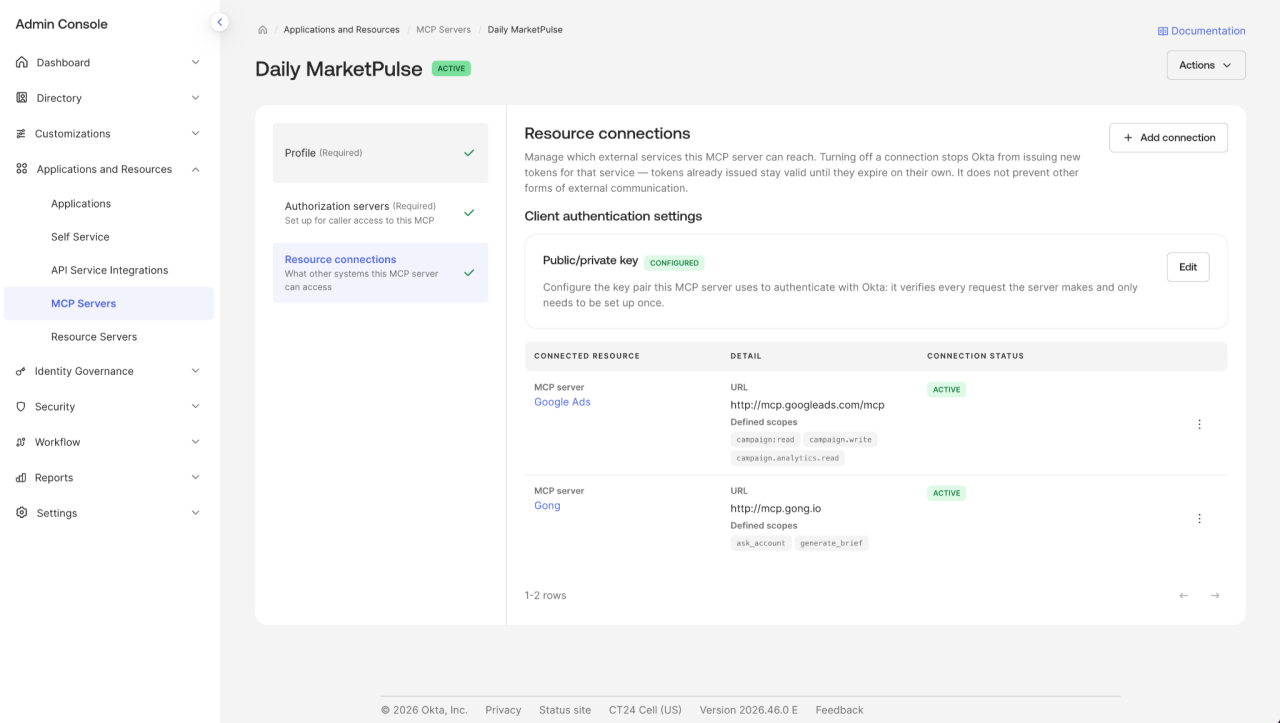
Admins can now enforce least-privilege access and user attribution behind internal MCP servers by registering the MCP server in Okta as an OAuth client with its own distinct identity and defining which downstream systems it can reach. Instead of forwarding a user's original token or relying on static API keys, the MCP server exchanges tokens with Okta to obtain short-lived, scoped access to the specific backend systems required for that task.
Standardizing this token exchange also removes a major bottleneck for engineering leaders. Rather than forcing developers to build and maintain custom authentication logic for every backend integration, platform teams can rely on a single, repeatable Okta token exchange to unlock faster agent delivery into production. And if an MCP server is ever compromised, the blast radius remains limited to that single-purpose token, preventing attackers from using standing credentials to pivot deeper into enterprise data.
Real-world example
A marketing team's Campaign Insights MCP server pulls pipeline data from Salesforce, email engagement from Marketo, and competitor mentions from Gong. By equipping the MCP server with its own Okta identity and scoped resource connections, each downstream system receives the original user's context and the full delegation chain. Security and compliance teams eliminate standing privileges past the first hop and get a complete, user-level audit trail across all downstream systems to pass compliance audits.
Prevent shadow AI data leaks: Govern third-party MCP servers with Cross App Access
Your AI agents do not only touch infrastructure you manage; they also connect to external SaaS tools sitting behind third-party authorization servers. Stopping unmonitored data leaks across those external connections requires an open standard that both your teams and third-party vendors can enforce.
The modern enterprise runs on dozens of SaaS platforms, each with its own authorization stack. Most platform vendors are built to govern their own ecosystem, leaving security teams with fragmented security policies and blind spots across third-party tools. Until now, connecting agents to external MCP servers meant employees approved access through scattered OAuth consent screens, creating unmonitored data flows on vendor infrastructure that IT cannot govern or audit. Those unmanaged tokens create shadow AI blind spots that attackers exploit and auditors flag. Security teams need a way to enforce the same central control over external MCPs running their own authorization servers.
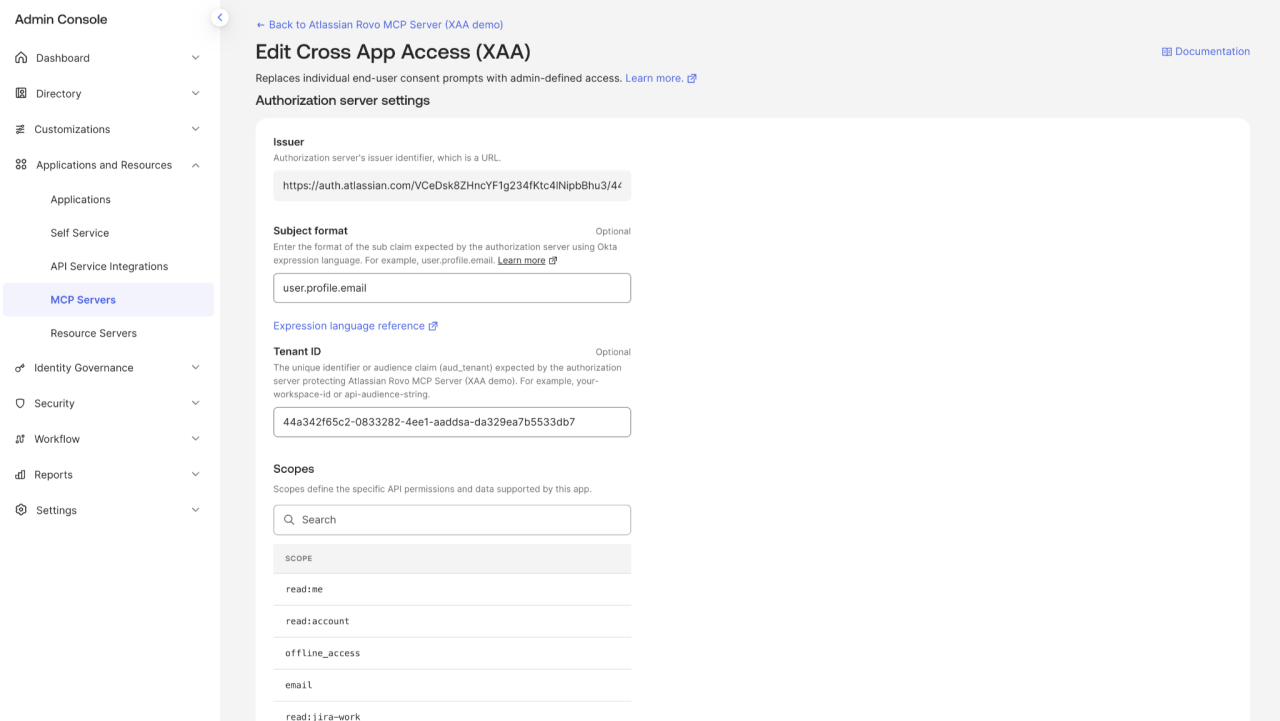
XAA is an open standard built on OAuth (using the Identity Assertion Authorization Grant, or ID-JAG) that lets an enterprise identity provider like Okta broker and govern token exchanges between AI agents, internal apps, and third-party servers without relying on unmonitored user OAuth prompts.
Expanded operational control
While XAA already secured connections between agents and internal MCP servers, we are now expanding XAA support to external MCP servers that support the XAA open standard. Administrators can now bring third-party authorization servers under central Okta governance to unlock safe third-party AI integrations at scale:
- Eliminate unmanaged third-party OAuth sprawl by selecting XAA—now the default protocol alongside Security Token Service (STS)—when configuring a resource in Okta.
- Accelerate time-to-value with pre-vetted SaaS ecosystems using out-of-the-box integrations from vendors publishing XAA metadata, including Linear, Notion, and Slack.
- Extend existing enterprise policies without rebuilding workflows by configuring your current single sign-on applications that expose MCP tools directly as governed resources.
Security teams can govern agent connections to external MCP servers using short-lived tokens tied to the requesting employee, enabling third-party AI adoption without compliance blind spots. Because XAA is an open standard, Okta works across any participating authorization server. Security leaders get a vendor-neutral control plane to enforce access policies and audit agent activity across their entire SaaS stack.
Okta for AI Agents: One control plane to unlock high-velocity, audit-ready AI across your enterprise
Your teams are deploying AI agents by the dozen. You shouldn't have to choose between moving fast and staying secure.
Okta provides a single control plane for AI agents in your enterprise, giving security and IT leaders one place to:
- Eliminate shadow AI blind spots by discovering unauthorized AI agents operating across your enterprise, unlocking full operational visibility.
- Preserve human accountability for compliance audits by assigning every agent a first-class identity and an accountable human owner to unlock provable compliance.
- Contain the blast radius of compromised prompts by authorizing and scoping agent actions at runtime, unlocking safe access to enterprise data.
- Cut off compromised workflows in seconds by revoking access with a single kill switch and governing the full agent lifecycle to unlock production rollouts with confidence.
Vendor-neutral by design, Okta for AI Agents works with your existing cloud environments, identity providers, and MCP infrastructure to help answer the Blueprint Alliance questions security leaders need to address.
Expanding beyond workforce identity use cases? Okta for AI Agents for Customer Identity extends identity controls to customer-facing, B2B, and partner agents.
Ready to become a secure agentic enterprise? Learn how Okta for AI Agents helps you get there.
These materials are intended for general informational purposes only and are not intended to be legal, privacy, security, compliance, or business advice. ©2026 Okta, Inc. and/or its affiliates.


