

Frontline workers keep the physical world moving. They assemble the products we rely on, keep store shelves stocked, and ensure goods move seamlessly across global supply chains. While these employees hold the keys to critical daily operations, the identity tools they use to get the job done weren’t built for their on-the-ground reality.
Multi-factor authentication (MFA) systems, a gold standard in security, were designed for workers with assigned desks, corporate email addresses, and dedicated devices at their fingertips—not glove-wearing line operators or store employees logging into a busy, shared kiosk. In these environments, traditional login methods can slow down the floor, making way for weaker security factors or risky workarounds.
Near field communication (NFC) helps change this dynamic. With Okta’s new support for NFC authentication, frontline workers get high-assurance, two-factor access with a simple badge tap and a PIN.
When seconds get multiplied by millions
Because deskless workers make up 70% to 80% of the global workforce, failing to protect their access creates a massive security vulnerability for businesses. Productivity is also at risk. With a workforce of that size, any small inefficiency (like a 15-second delay during shift handoffs or inventory lookups) is amplified thousands of times a day.
These roles also turn over at nearly twice the rate of office workers (26% annually versus 16%), which turns manual onboarding and static passwords into major security liabilities. Badge-based authentication solves this by keeping high-turnover teams individually verified and auditable from day one.
For Okta customer Darling Ingredients, secure and efficient identity operations are essential to delivering on their purpose: transforming millions of tons of material from the animal agriculture and food industries into sustainable food, feed, and fuel.
“An NFC and PIN solution would allow us to maintain a strong security posture while reducing user and management friction associated with long passwords and other, more expensive credential options that just aren’t suitable for our typical work environment,” said David Daniels, Director, Enterprise Technology at Darling Ingredients.
Authentication built for the floor
On the frontline, phones are often banned from the floor, gloves make touch-based authentication impossible, and there's no time to fumble through multi-step, password-centric flows when a customer is waiting. Meeting frontline workers where they are requires an authentication system designed for the physical realities of fast-paced, shift-based work.
With Okta’s NFC support, deskless workers can sign in to Okta-protected applications on Windows workstations with an NFC badge tap and a short PIN. Identities are verified in seconds, without a phone, password, or camera. Okta supports multiple NFC token types, so companies can choose between low-cost badges for high-turnover shift teams or tamper-proof, hardware-protected cards where security requirements are stricter.
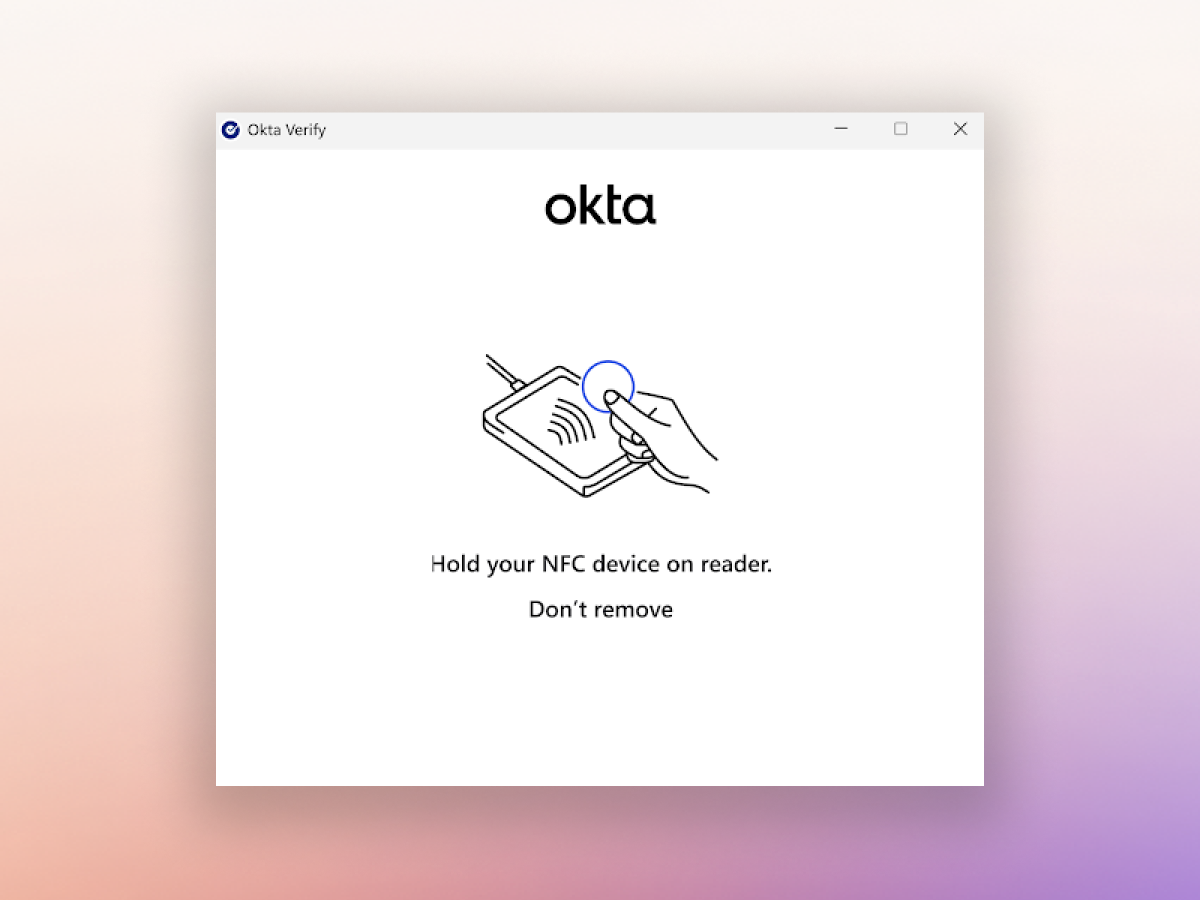
Because NFC works directly within Okta, managing frontline staff doesn’t require separate identity security tools or new IT systems. Teams set up, manage, and protect shift workers using the same Okta Platform they already use for desk workers. When a frontline worker joins, their NFC credential is provisioned through Okta. When they leave, it's deprovisioned automatically, auditably, and at scale.
Closing the frontline coverage gap
Frontline roles are as old as industry itself, but digital identity security wasn’t necessarily designed with this integral workforce in mind. With authentication built for how shift teams actually work, companies no longer have to choose between speed on the floor and security across the enterprise. NFC brings immediate operational and security advantages.
On shared terminals and kiosks, individual tap-and-PIN sign-ins replace shared credentials and sticky-note passwords, bringing high-assurance MFA protection to those stations.
Removing password friction also gives minutes back to every worker on every shift and reduces the password-reset tickets sent to IT help desks.
Because credentials run through the same platform used for corporate staff, IT teams can more easily automate onboarding and offboarding, while attributable logins help support compliance frameworks on shared devices without relying on personal phones.
How to get started with NFC
NFC Authenticator is currently available in self-service Early Access for managed Windows environments.
Existing customers: Review the product documentation to enable NFC Authenticator directly within the Okta Admin Console.
Exploring Okta: Learn more about Adaptive MFA or talk to our team about how NFC authentication fits into a broader workforce strategy.
Any mention in this article of solutions, features, functionalities, certifications, authorizations, or attestations that are not currently generally available or have not yet been obtained may not be delivered or obtained on time or at all. We assume no obligation to deliver on such items and you should not rely on them to make your purchase decisions.