Productos
Nuestras plataformas protegen todo tipo de identidad: desde identidades de agentes de IA hasta las identidades de sus clientes, empleados y socios.
Nuestras plataformas protegen todo tipo de identidad: desde identidades de agentes de IA hasta las identidades de sus clientes, empleados y socios.
Okta es una plataforma neutral, potente y extensible que coloca la identidad en el centro de su pila tecnológica.
Okta y Auth0 ofrecen un acceso flexible y seguro. Desarrolle con rapidez con nuestras plataformas extensibles para clientes, personal e identidades no humanas.
Nuestras plataformas protegen todo tipo de identidades: desde identidades de agentes de IA hasta las identidades de sus clientes, empleados y socios.
Nuestras plataformas protegen todo tipo de identidad: desde identidades de agentes de IA hasta las identidades de sus clientes, empleados y socios.
Okta es una plataforma neutral, potente y extensible que coloca la identidad en el centro de su pila tecnológica.
Okta y Auth0 ofrecen un acceso flexible y seguro. Desarrolle con rapidez con nuestras plataformas extensibles para clientes, personal e identidades no humanas.
Nuestras plataformas protegen todo tipo de identidades: desde identidades de agentes de IA hasta las identidades de sus clientes, empleados y socios.
Abstract
Traditional authentication methods that rely on usernames and password integrity are widely considered to be broken. As organizations begin to move more sensitive data to cloud apps to take advantage of the productivity gains, the traditional perimeter expands to wherever the user is logging in from.
In other words, the identity becomes the perimeter. Threat agents have recognized this as a security gap and are exploiting your employees' tendency to reuse passwords across personal and professional accounts, among other weaknesses. Let’s discuss the types of identity attacks that are most likely to impact your organization.
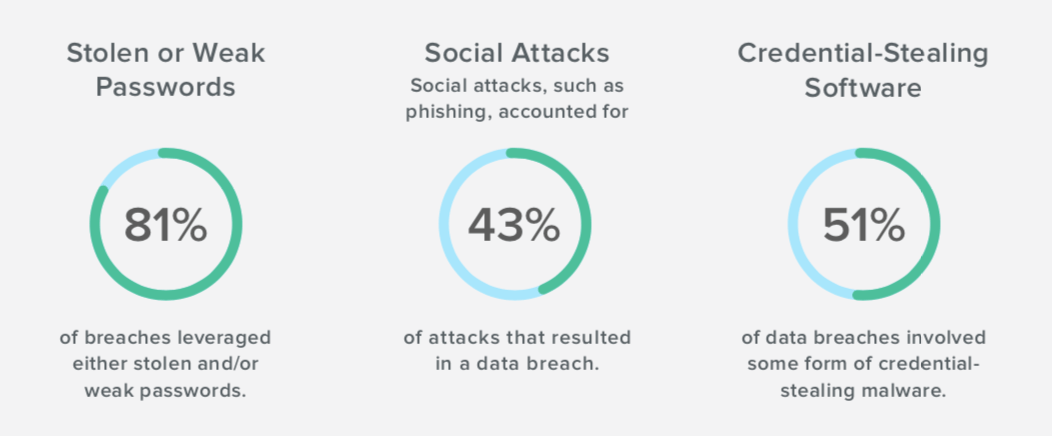
Traditional authentication methods that rely on usernames and password integrity are widely considered to be broken. In fact, “Broken Authentication” sits at #2 in the OWASP Top 10 for application security risks. As organizations begin to move more sensitive data to cloud apps to take advantage of the productivity gains, the traditional perimeter expands to wherever the user is logging in from. In other words, the identity becomes the perimeter. Threat agents have recognized this as a security gap and are exploiting the natural proclivity for your employees to trust an inbound email from a familiar source, or their tendency to reuse passwords across personal and professional accounts. Let’s discuss the identity attacks that are most likely to impact your organization.
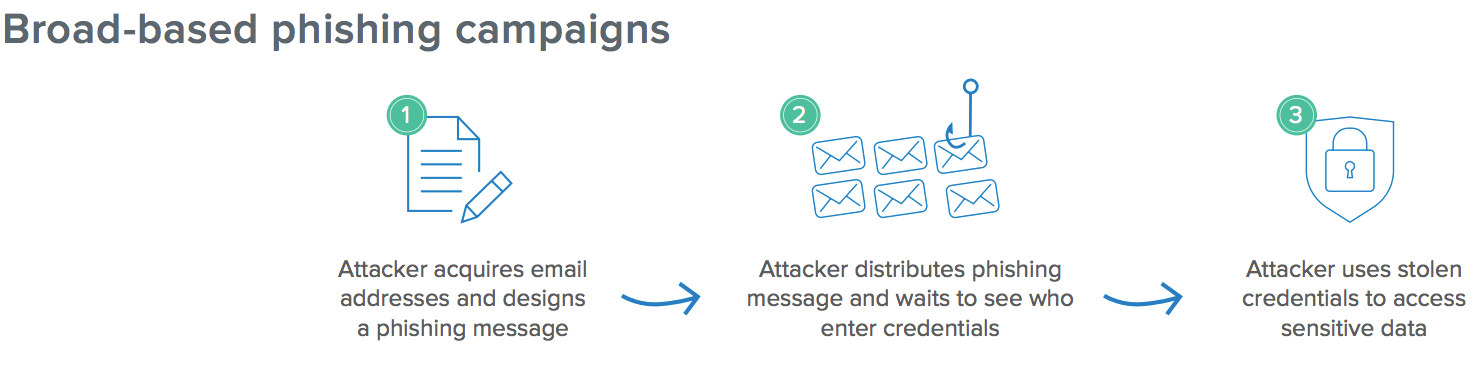
Why are phishing campaigns such a popular method of attack?
Simply put, the numbers are in the attacker’s favor. A broad-based phishing campaign recognizes that threat agents have to gain access to only a few accounts or one admin account to compromise the organization. Yet with just a light touch of social engineering and a list of email addresses, phishing attacks can successfully compromise 1 out of 20 employees from even a well-trained organization.
Credential theft from phishing is often the first stage of the cyber kill chain. According to the Verizon 2017 Data Breach Investigations Report, 81% of breaches used stolen and/or weak credentials.
Anatomy of the attack:
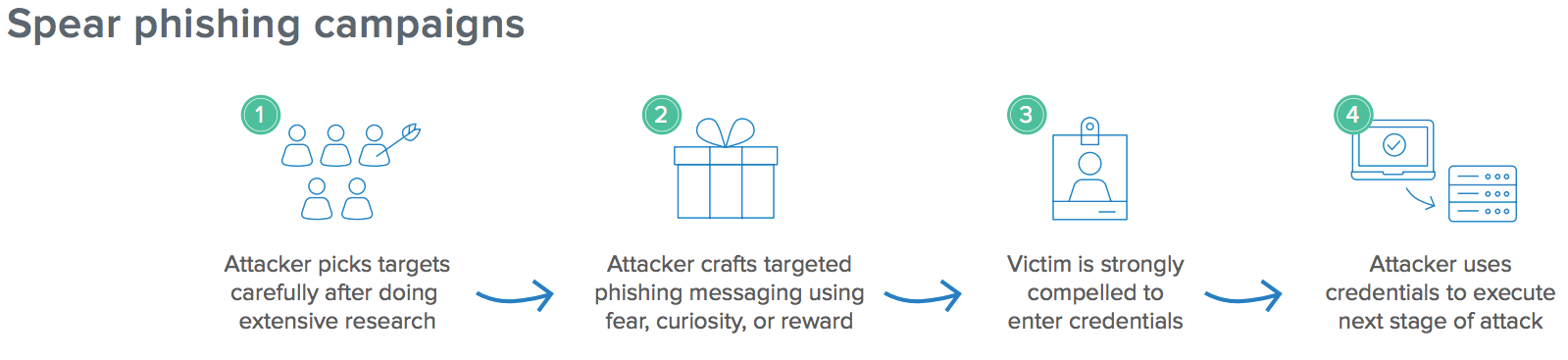
Spear phishing is a targeted form of phishing that often involves more research designing the target list and phishing message. As opposed to broad-based campaigns, spear phishing typically focuses on a small number of employees to evade automated filters. The level of social engineering is also more sophisticated, with messages being more personal and the malicious call-to-action playing on emotions such as curiosity, fear, or rewards.
Anatomy of the attack:
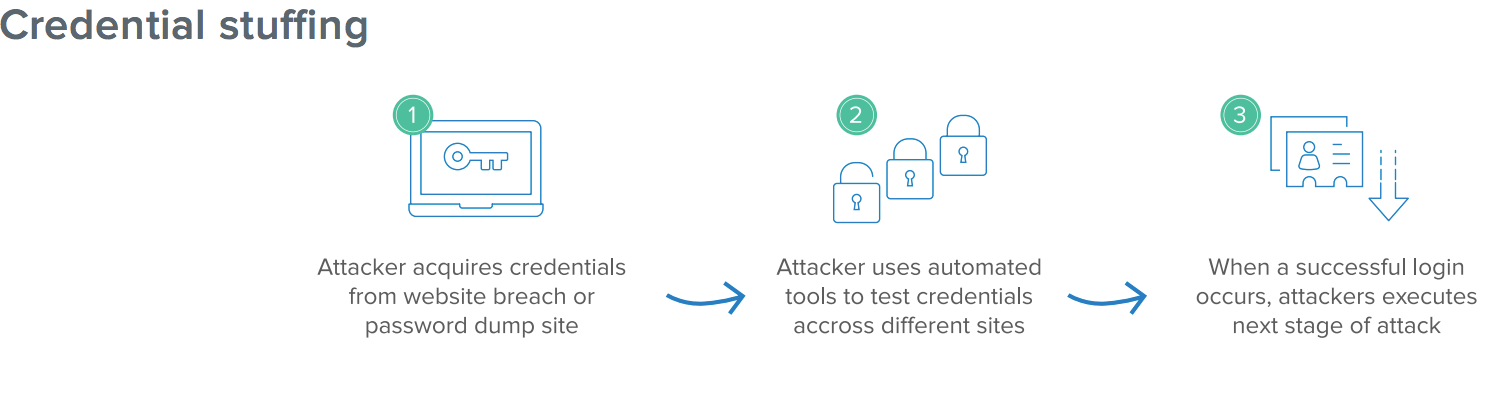
Credential stuffing is a form of brute force attack that takes advantage of our struggle to select unique passwords across our various accounts. This is hardly surprising when you consider that the average American internet user has 150 online accounts requiring a password. Yet many of us have had account credentials compromised as part of a data breach.
Attackers leveraging credential stuffing will use these compromised credentials on several other websites to test if the login details are re-used. And they often are: 73% of passwords are duplicates, according to the TeleSign 2016 Consumer Account Security Report.
These types of attacks can be done at scale by bots, leading to a higher likelihood of these attacks affecting your organization. According to a recent report from Akamai, “more than 40% of global log-in attempts are malicious thanks to bot-driven credential stuffing attacks”.
Anatomy of the attack:
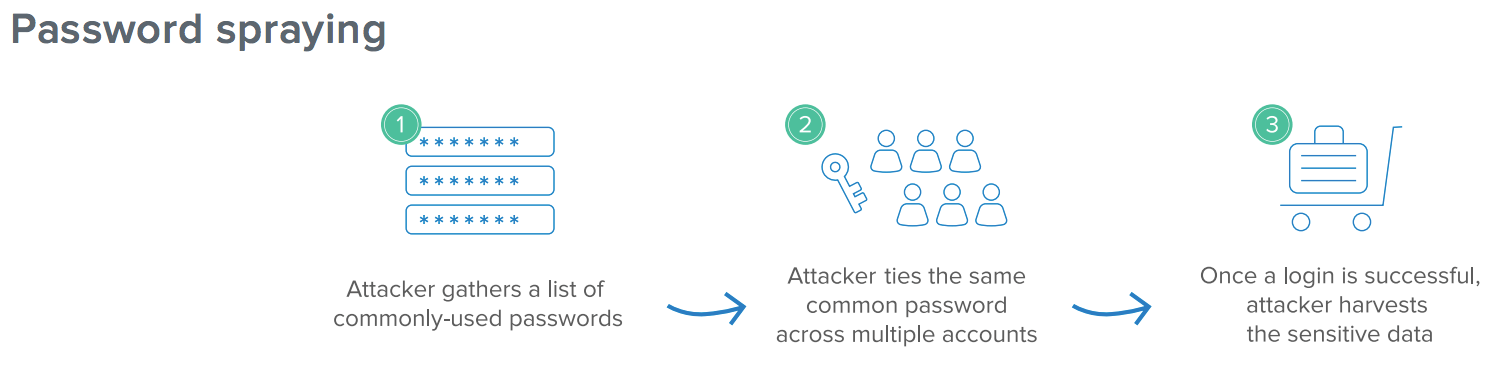
Password spraying is another form of brute force attack whereby an attacker takes advantage of our tendency to rely on common passwords such as “password1” (which according to Pwned Passwords has appeared in a data breach over 2.3 million times!).
Anatomy of the attack:
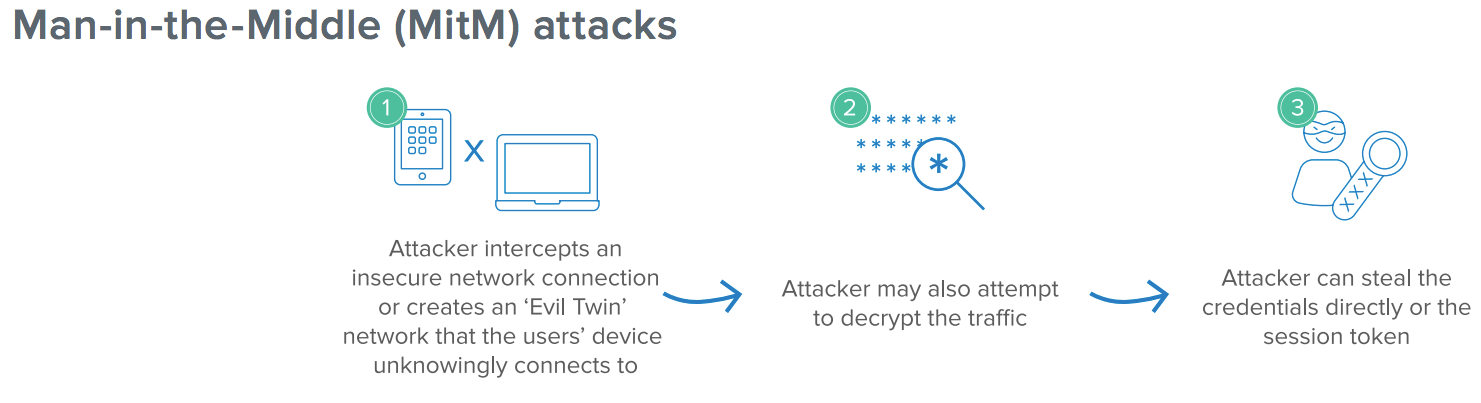
A MitM attack on an organization is a highly targeted attack that can result in a full take of credentials and data-in-transit if executed correctly. After intercepting a network connection, an attacker can also take advantage of “session hijacking” that compromises the web session by stealing the session token.
Anatomy of the attack
As the identity becomes the new security perimeter, organizations that take an identity-driven approach to security are finding that these attacks are able to be prevented without impacting user experience.
While it’s certainly important to educate employees of these identity attacks and implement best security practices like data encryption and certificate pinning, implementing MFA across your apps will significantly reduce the risk of successful attacks. MFA prevents phishing attacks by requiring a second factor to access sensitive corporate data, such as a lightweight push to the user’s mobile device for authentication. This means that even if an attacker has your credentials, they still will not be able to be authenticated into the app.
MFA therefore also prevents credential stuffing and password spraying since stolen or weak credentials are not sufficient to gain access. If MFA is paired with modern identity solutions, organizations can also set policies against the use of compromised or common passwords that leave employees vulnerable to these attacks.
Minimizing MFA prompts should also be a key consideration, and by implementing modern Adaptive MFA, the second factor challenges are only surfaced under more risky scenarios, such as when the login occurs off the corporate network.
Moreover, organizations can apply especially strict MFA policies for business-critical apps or privileged users, providing an effective layer of defense against spear-phishing attacks.
Finally, MFA can prevent man-in-the-middle attacks by ensuring that if credentials are stolen in transit, a second factor is still required to access the account. Even more sophisticated attacks that attempt to steal a one-time password as part of the attack can be prevented by leveraging more secure authenticators like a U2F security key.
In light of these identity risks, NIST has recommended organizations implement MFA as part of their Digital Identity Guidelines.
Check out our product page to learn more about implementing Adaptive Multi-factor Authentication with Okta and how we can help prevent identity attacks on your organization.


