





Executive summary
Okta’s dedicated waste management program centers on creating healthy, low-impact physical spaces that minimize landfill waste. This four-part blog series covers our strategy for decarbonizing our real estate footprint using green procurement and green lease standards, establishing global consistency in operational waste management, prioritizing healthy workspace design via LEED and WELL certifications, and mindfully engaging our employees in our program.
In this blog, we will discuss:
- Waste management: How we manage waste throughout Okta’s global operations to align with downstream waste haulers’ restrictions while practicing mindful procurement
- Low-impact procurement: How we establish sustainable operational guidelines for sourcing food and beverages, office supplies, and workplace materials
- Construction waste diversion: How we partner with contractors to divert construction waste and reuse furniture.
- Measuring impact: How we use waste audits to continuously improve our diversion rates and community impact
Waste management program overview
Our program embraces a reuse and repurpose mindset across our operations and real estate construction projects, tackling upstream procurement to avoid waste generation from the start and downstream waste management to divert as much material as possible from landfills. As part of our global operations, we have identified four ways to maximize our efforts to reduce waste: composting, e-waste diversion, construction waste diversion, and furniture reuse.
Mandatory in-office composting stream
A core part of our program is to require all our offices to participate in recycling and composting efforts. If neither the landlord nor the municipal waste hauler offers composting, we partner with local composting vendors globally so our offices have a divertable organic waste stream.
For example, in our New York City office, we partner with Common Ground Compost, which repurposes organic waste for local community gardens. In Washington DC, we partner with Veteran Compost, an organization that hires veterans to collect organic waste and sell compost to local farms. These partners help fill the gap in municipal composting while truly embracing circularity within the local communities where Okta employees live and work.
Non-divertable materials
The best path forward for Okta is to focus on low-waste procurement and maintain consistent training across our three primary waste streams: landfill, recycling, and composting. We are actively launching gamified challenges and training modules to more effectively sort waste in accordance with local municipal requirements.
To target hard-to-recycle items, we piloted TerraCycle bins at our Bellevue, Washington, office. Because standard municipal facilities cannot process certain complex materials, these dedicated bins were introduced to collect:
- Snack packaging: individual wrappers, chip bags, and flexible plastics
- Office supplies: used pens, markers, binders, and plastic desk accessories
Because TerraCycle specializes in redirecting niche materials that standard municipal recovery facilities cannot process, this pilot allows us to evaluate operational workarounds for difficult waste categories before scaling them to other offices.
E-waste diversion
As a SaaS technology company, Okta’s hazardous waste generation is null, though we generate significant electronic waste (e-waste), totaling 1.66 metric tons in FY261. Managed by our Technology, Data, and Intelligence (TDI) team, we properly dispose of or repurpose our laptops and other hardware through our specialty recycling partner, Revivn, who refurbishes what they can and safely disposes of the rest. Through this program, we have donated $25,000 from the revenue generated by these repurposed assets to a variety of nonprofits so far in FY27, and Okta matched that donation as a second donation directly to Revivn’s Tech Access Program.
This close internal alignment also allows us to scale and offer engagement programs for our employees. For example, during Earth Month every year, the TDI team establishes collection points across all of Okta’s direct-leased offices for an in-office drive so employees can drop off personal electronics for proper disposal.
As a cybersecurity company, this internal partnership with the TDI team bridges environmental responsibility with uncompromising data privacy. To protect sensitive information, the TDI team ensures strict device sanitization for all electronic assets. All handled data is destroyed either via a destructive write process meeting US Department of Defense (DoD 5220.22-M) standards or through physical destruction in accordance with NIST SP 800-88 Guidelines for Media Sanitization. This rigorous security baseline allows us to confidently maximize our global recycling footprint.
Construction waste diversion
As we continue to grow and build offices globally, we prioritize construction waste diversion and sustainable material sourcing when engaging with construction management vendors. Anchored by LEED certification standards, we commit to achieving at least LEED Silver certification and aim to achieve a 75% construction waste diversion rate. LEED’s construction and demolition waste management framework helps our contractors document and actively manage waste diversion, rather than defaulting to landfill disposal.
Partnering with NovoSustainability, we align our real estate projects not only to meet but to exceed LEED standards. In 2024, our San Francisco and Tokyo projects achieved 76% and 98% diversion respectively2. As Okta expands its operations in Bengaluru, India, we face significant challenges diverting waste in a region where historically less than 1% of construction debris has been recycled. To overcome this systemic gap, we collaborated with our build partner, JLL, to increase construction waste diversion from 30% to 46% on our second expansion project3. We achieved this diversion increase through strict on-site source segregation, prioritizing sustainable local materials, and vetting reliable waste-hauler partnerships to guarantee traceable, responsible disposal.
Furniture reuse and repurposing
When designing and furnishing Okta spaces, we prioritize reusing and repurposing existing furniture and architectural assets to extend their life and reduce waste. When new purchases are needed, we source from sustainability-focused manufacturers that incorporate circular design principles and responsible material sourcing, including Andreu World, MillerKnoll, Steelcase, and Allsteel. We also procure Energy Star-certified equipment whenever available to help reduce the environmental impact of our workplaces.
Okta’s global procurement guidelines
Okta is mindful about products, operational materials, and equipment used to furnish and operate our office spaces. As a result, we embed procurement guidelines with our workplace global operations team. These guidelines apply to 10 different countries where Okta has direct-leased offices.
To avoid a strict, one-size-fits-all approach, we allow for flexibility in geographic, product, and cultural differences in local materials and behaviors. We use the global guidelines as guardrails and work with local entities to procure products packaged in materials we can divert from landfills.
Here is an overview of our global procurement guidelines:
Food and beverage
- Opt for no plastic beverage containers (prioritizing aluminum containers)
- Minimize single-use products (such as silverware and individual packaging)
- Opt for bulk snacks and nutrient-dense options (such as fruits and vegetables to align with WELL Building Standard criteria)
Office supplies and building materials
- Source sustainable office supplies
- Opt for automatic double-sided printing
- Prioritize non-harmful building materials
- Use energy-efficient LED lighting
Measuring and scaling diversion
As part of Okta’s ongoing waste management efforts, we invest in measuring progress to verify that we meet our program expectations. Our waste audit partner, All About Waste, visits our direct-lease offices globally to conduct physical waste stream audits of our office and building setups, diving deeply into each waste stream and flagging common contaminants. The waste auditors provided feedback on infrastructure, waste signage, and employee training to increase diversion.
All of our new custom waste signage, designed by Johnny Lemoine, incorporates feedback directly from these waste audits. For example, after discovering that Dublin office employees frequently placed aluminum cans in the landfill stream, we updated the landfill signage, striking out aluminum cans to highlight them as a commonly misplaced item. We also aligned our practices with local infrastructure, noting that the Dublin municipality uses grey bins for landfill, green bins for recycling, and brown bins for composting. To further our local impact, the Dublin office donates cans and bottles to raise funds for the Dublin Simon Community.
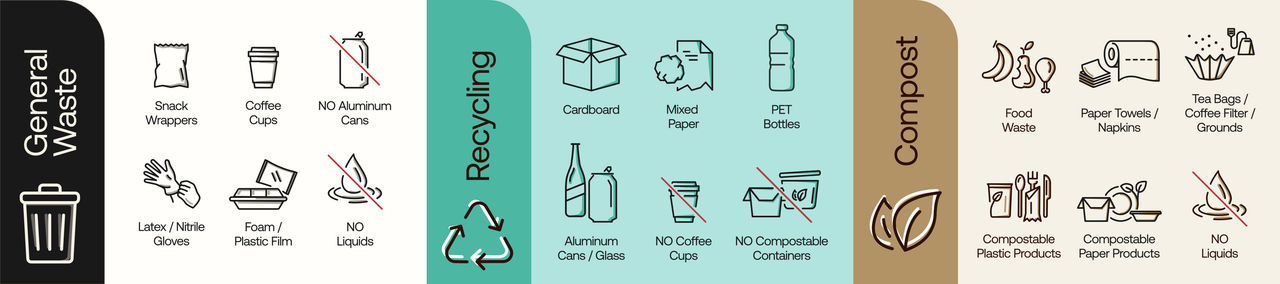 Okta Dublin’s custom waste signage features clear, color-coded streams for General Waste, Recycling, and Compost—perfectly matching the local municipality's bins.
For sites with lower waste diversion rates, such as our Sydney office, we plan to re-audit the following year to measure the tangible impact of our adjustments. Waste auditing will continue as we balance assessing new sites with tracking progress at our existing locations.
We also celebrate exceptional waste diversion performance, such as our Bengaluru site, which achieved 93.3% diversion rate in its 2025 waste audit4. In response to this achievement, we are actively gathering information to evaluate our readiness for TRUE Zero Waste Certification. This certification takes a comprehensive look at all waste streams, waste haulers, landlords, and infrastructure to award points for zero-waste efforts. We are excited to better understand the certification process and to apply the resulting learnings, training, and infrastructure principles across our global office portfolio.
Core waste management principles
We are continually iterating on our waste program because effective waste management requires ongoing training, tracking, feedback, and education for all stakeholders, including employees, operations teams, and landlords.
If you’re thinking about developing your waste management program, we suggest keeping these core principles in mind:
- Measure and evaluate existing waste streams: Whether using landlord-provided waste data or hiring a third-party waste audit vendor, first establish a baseline and then measure continuously. Establishing a waste-tracking system by building/site also helps improve environmental reporting and identify new diversion opportunities.
- Partner with workplace operations and local market offerings: We have found waste management programs are effective when tailored to local infrastructure and market conditions. Work closely with onsite workplace teams to identify available recycling and composting services and reduce avoidable waste streams, including plastic packaging.
- Align closely with construction partners: Close alignment between construction teams and those managing daily workplace operations prevents gaps in your sustainability strategy. Standardized waste signage and diversion practices across locations can create a more consistent employee experience.
- Engage employees: Designing thoughtful waste-diversion training materials is a challenging yet crucial piece of the puzzle. Deploy these materials in an engaging way with multiple touchpoints across the office.
- Partner with key operational teams: Engage and train whichever teams touch downstream waste (such as kitchen staff, janitorial services, and snack vendors) to sort waste from inception to disposal.
- Rinse and repeat: Successful waste management programs are living systems, meaning there is no end to waste management. Continuously review progress, audit procurement, monitor vendors, engage employees, and collaborate with partners to expand data and improve diversion.
Want to learn more about how Okta is building healthy, low-impact spaces for our global workforce? Explore Okta’s sustainability initiatives and how we’re driving climate impact.
1 FY26 e-waste volume (1.66 metric tons) was calculated using a standard baseline of 3.0 lbs per laptop (1,100 repurposed laptops total), combined with the verified recycled e-waste (327 lbs) recorded in Okta’s Revivn Annual Impact Report.
2 San Francisco’s 75% and Tokyo’s 98% construction waste diversion data were uploaded to LEED Online on January 22, 2024, and May 21, 2024, respectively, and approved through the LEED certification review process.
3 Bengaluru’s 30% and 46% construction waste diversion data from general contractors were uploaded to LEED Online on January 9, 2025, and December 18, 2025, respectively, and approved through the LEED certification review process.
4 93.3% diversion rate is derived from the comprehensive Zero Waste Audit Report conducted at the Okta Bengaluru office on September 26, 2025, by All About Waste.


