


Businesses at Work Report 2026
Agentic AI readiness is identity readiness
You already know that AI agents are changing your business. This year, explore the latest agentic AI trends, global adoption patterns, and identity insights to help you stay ahead of the curve.

A snapshot of this year's report
See how organizations are approaching AI agents and the identity challenges shaping adoption.
AI agent adoption is cautious
The data suggests leaders are moving deliberately on AI agents as they evaluate security and identity risks before committing to production at scale.
of organizations have limited to moderate AI agent adoption
Identity concerns are slowing AI agent adoption
Leaders are less concerned with what agents can do and more focused on AI governance, identity, and access risks.
cite AI governance and IAM as their top concern
The first line of defense is under pressure
Credential-based attacks are rising across industries, increasing pressure on authentication systems as organizations expand access for AI agents.
threat acceleration vs. high-assurance authentication adoption
Identity risk varies by region
The global average doesn't tell the whole story. Discover how threat-to-authentication ratios vary by region and what the threat landscape looks like where you operate.
- Germany
- Canada
- Italy
- United States
- United Kingdom
- Australia
- Netherlands
- Switzerland
- Singapore
- France
detected threats per authentication
detected threats per authentication
detected threats per authentication
detected threats per authentication
detected threats per authentication
detected threats per authentication
detected threats per authentication
detected threats per authentication
detected threats per authentication
“AI agents are evolving faster than any software before them, making traditional security models obsolete. Speed is now a given, but security is the differentiator.”

An identity strategy built for agentic AI
At machine scale, bottlenecks become backdoors and human error becomes a critical vulnerability. See the analysis on how to evolve your governance for the AI era.
Authentication built for human scale is obsolete
Even as strong MFA adoption grows, the sheer volume of authentications amplifies any weak factor into a major security gap.
- High-assurance MFA adoption grew from 41% to 58%.
- Authentication volume is outpacing strong authentication coverage.
Governance built for a new era
As AI introduces continuous access changes, manual approvals transform from simple bottlenecks into major security risks.
- Access requests have surged more than 12x and access certifications have surged more than 9x over the past two years.
We still haven't solved the non-human identity problem
AI agents will increasingly act through service accounts and other non-human identities. Most organizations still lack the governance needed to secure them.
- 78% cite controlling non-human identity access and permissions as a top concern.
- Only 10% have a strategy for governing them.
One identity security fabric. For humans and AI.
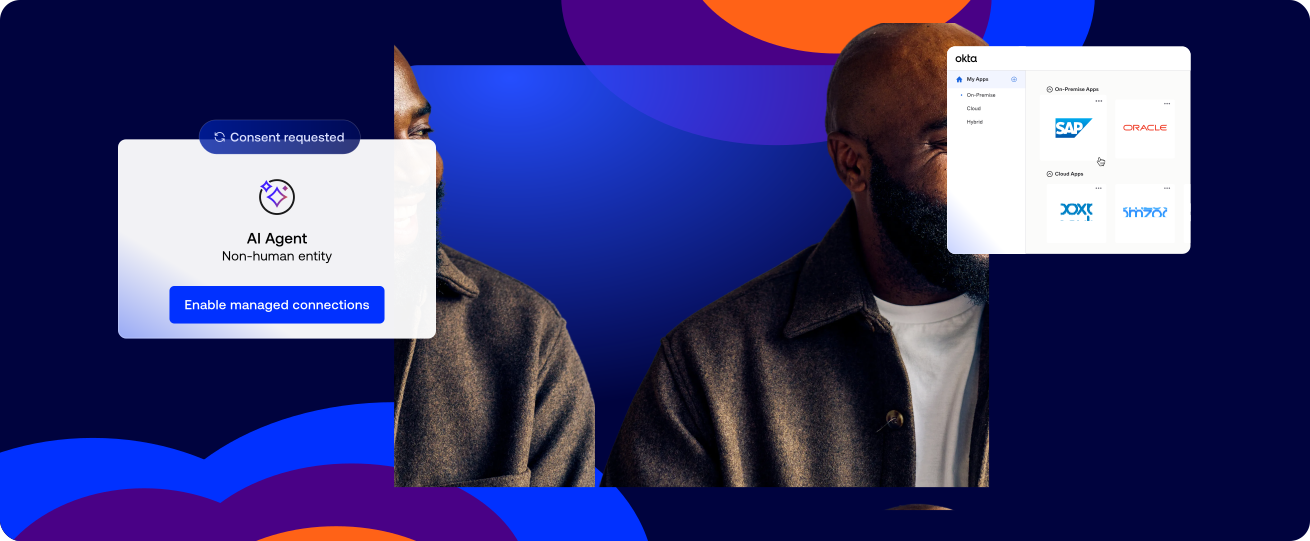
As AI agents deploy across the enterprise, organizations need a solid identity foundation. The Okta platform brings the identity security fabric to life by connecting authentication, governance, and access across human and non-human identities.
Explore more


Frequently asked questions
Identity security is critical because agentic AI operates at machine scale, where human bottlenecks can quickly become security backdoors. As organizations deploy autonomous agents, “agentic AI readiness is identity readiness”—meaning success depends on a unified identity fabric that governs both human and non-human identities to prevent unauthorized access or “shadow AI” risks.
While enterprise enthusiasm is high, adoption is widespread but still “measured” and “cautious”. The vast majority of businesses—82% combined—report their AI agent usage as either “moderate” or “limited”. Leaders are moving deliberately to address identity, governance, and compliance risks before moving these autonomous systems into full-scale production.
According to the 2026 report, being ready for AI agents is actually about being ready for identity security. To stay ahead, companies must move toward implementing an “identity security fabric”. This bridges the gaps in how they handle logins, permissions, and automated account oversight so that their security system works seamlessly for both people and software-driven identities.
The main hurdles aren’t what the AI can do, but how it is governed. 58% of leaders worry most about identity management and access risks. Furthermore, 78% of organizations struggle with managing “non-human” identities—like the service accounts AI uses—and a staggering 90% of companies still don’t have a clear plan to secure them.
As AI agents introduce continuous access changes, manual approvals have transformed from simple administrative tasks into major security risks. Access requests and certifications have surged more than 8-11x over the past two years, making it nearly impossible for humans to keep pace with the velocity of agentic workflows without automated governance.
The volume of detected threats is “exploding”, particularly in sectors with historically less robust identity infrastructure. Nonprofits saw their threat-to-authentication ratio soar to 78% this year, up from 18% the previous year. Wholesale trade ranks second with a 44% ratio. Energy, mining, oil, and gas follows at 29%.