




Executive summary
New Okta Identity Governance capabilities give you the visibility and control to shift from reactive to continuous governance. You can now spot out-of-band changes with Identity Reconciliation, bundle role permissions using Resource Collections, and automate assignments through birthright policies. Plus, Intra-app SoD for groups blocks risky access combinations, while Integration Builder brings custom apps under governance without coding.
Your governance program is only as strong as its view of access. But app administrators can change permissions directly in their applications, outside the visibility of your identity governance solution, and those changes may remain hidden until the next audit.
Core enterprise entitlement governance challenges
As access spreads across more apps and identities, manual, fragmented governance leaves entitlement risk unaddressed, creating security vulnerabilities and slowing teams down. Most enterprises face these four governance challenges as a result:
- Blind spots: When changes are made directly in apps, entitlement drift and rogue accounts go undetected, leaving excess permissions in place that may expose the organization to security risk. Without an easy way to compare what was approved against what actually exists, audit prep gets costly: teams spend hours gathering evidence across systems and reconciling it by hand.
- Inconsistent and manual provisioning: Organizations lack a single, clear understanding of the baseline access a user role should have. Instead, privileges are pieced together based on individual group, app, and entitlement assignments. As a result, access provisioning is slow and inconsistent whenever employees join or change roles, leaving admins to spend time on repetitive tasks rather than strategic work.
- Toxic access combinations: Organizations lack the means to detect and block the assignment of entitlements that add up to a risky combination of permissions. Without rules to enforce the separation of duties, a toxic combination can be approved before anyone notices, and reviewers may not catch it until a certification, if at all.
- Apps that can't be connected: Not every application supports SCIM or other protocols out of the box, so those apps sit outside the automated provisioning, time-bound access, and revocation policies the rest of your apps follow, leaving them governed in a silo.
Overview: New Okta Identity Governance capabilities
Okta Identity Governance closes these gaps with several new features:
- Identity Reconciliation (Early Access): Detects entitlement drift and rogue accounts so that you can see and reconcile access changes made outside Okta.
- Resource Collections (Generally Available): Bundles the baseline apps, groups, and entitlements that each role needs into a single item, simplifying how you model roles and assign access.
- Policies to support birthright access (Early Access): Automatically assign collections through policies based on user attributes, so access updates as people join, move, or leave.
- Intra-app Separation of Duties (SoD) for groups (Early Access): Automatically blocks requests for groups that would create a toxic combination of access, helping enforce least privilege.
- Integration Builder (Generally Available): A tool to help build custom app integrations by mapping customer-owned APIs to Okta for provisioning and entitlement management, all without requiring protocol or engineering knowledge.
Together, these features give you greater flexibility in managing fine-grained entitlements and transforming governance from fragmented and manual to continuous and security-driven.
Identity Reconciliation: See what access changed outside Okta
Let’s start with visibility, because you can't govern what you can't see.
Identity Reconciliation adds a verification layer to governance: A regular comparison of the privileges that actually exist in downstream apps against those Okta assigned. Through manual or scheduled imports, Okta detects entitlement drift and rogue accounts, providing a comprehensive view of out-of-band access changes in a dedicated reconciliation tab, with the context needed to make informed corrections and reconcile those differences with the permissions managed in Okta. As a result, access stays centrally managed in Okta Identity Governance, and nothing changes without your knowledge.
That visibility also takes the scramble out of audit prep. Every drift and every action produces a detailed audit trail with before-state, after-state, actor, timestamp, and action taken, so evidence is ready before anyone asks for it. For the riskiest apps, optional per-application entitlement auto-revoke policies go a step further by automatically removing entitlement drifts without manual follow-up.
Watch: Identity reconciliation capabilities in action
Check out this quick demo to see how Identity Reconciliation capabilities make it easy to detect, govern, and remediate entitlement drift and rogue accounts.

Resource Collections: Easily assign privileges by role
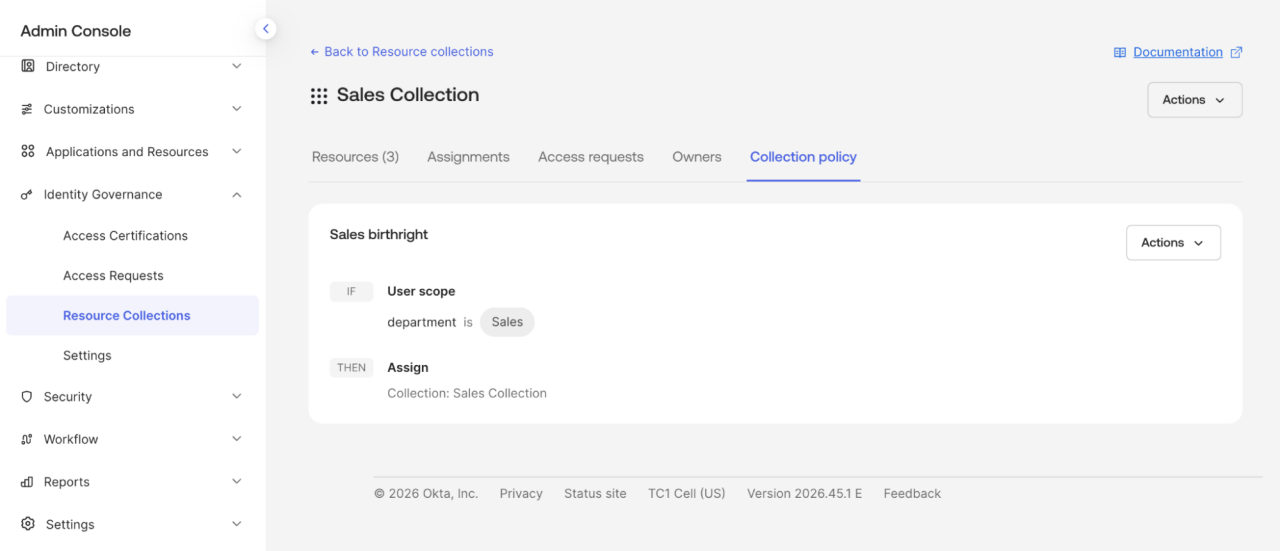
Once you can see access, the next step is to make it simpler to define who should have it. A Resource Collection allows you to define the baseline access for a specific role or function. It can represent a role, such as "Engineering," "Claims Adjuster," or "Contractor—EMEA," and bundles the basic apps, groups, and entitlements that role needs to get started. Users can request or be assigned a specific Resource Collection manually or automatically through policy, and admins and auditors can certify who has access to, and what is in, a collection.
Collections provide greater visibility than access assignment through groups. In Access Requests and Access Certifications, requestors and approvers can see what a specific role or collection provides (such as groups, apps, and entitlements) so they have the context to make high-quality decisions. Requestors see what access they can get before they ask, and auditors can see what access each role carries by auditing its collection.
Resource Collections is already Generally Available, but a new Early Access feature now supports creating policies, such as those for birthright access. Write a Resource Collection policy once, and let Okta automatically assign collections at key lifecycle stages, such as employee onboarding. Assignments update as people join, move, or leave, so everyone in the same role gets consistent access during onboarding and as attributes change. And when it comes time for offboarding, users are automatically deprovisioned without IT intervention.
Intra-app SoD for groups: Block toxic combinations of group assignments
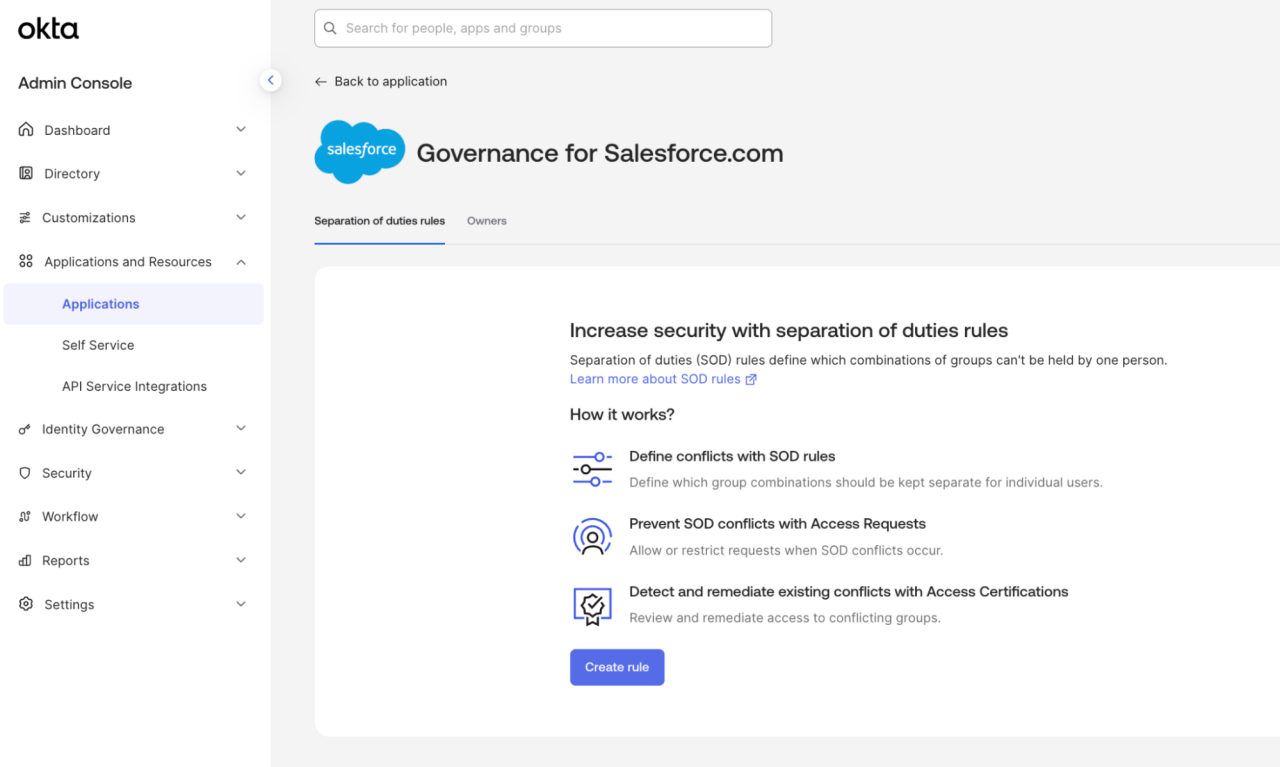
With access visible and roles defined, SoD is only one of many Okta Identity Governance features that help enforce least privilege. Until now, customers could define SoD policies for entitlements to block toxic combinations of access, preventing fraud while enhancing security. Okta's SoD policies now extend to group-based access. Write rules for groups that assign access, and Okta automatically enforces these rules by blocking requests at submission if they would create a toxic combination of access within a single app. During certification campaigns, visibility into existing SoD conflicts helps reviewers identify and clean up risky access already in place.
Integration Builder: Build API-based integrations for your applications
Not every application supports SCIM or other protocols out of the box, but many expose APIs. Integration Builder, a feature of Okta Workflows, lets you build API-based integrations to those applications, so non-SCIM resources are governed under the same automated provisioning, time-bound access, and revocation policies as your native SCIM apps.
With Integration Builder, you can leverage API Integration Actions to map and trigger API calls to create, read, update, or revoke user access, entitlements, and group memberships in third-party systems, without writing traditional code. When a user is assigned or unassigned, or when an access request is approved, Okta triggers a lightweight API action that communicates directly with the app's native endpoints.
Proactively define access terms before risk accumulates
Okta Identity Governance enforces least privilege across every identity and resource with governance built for enterprise scale. Now, with these new features, organizations can more easily shift from periodic, reactive governance to continuous, contextual governance that lets security teams stop chasing entitlement sprawl after the fact and start dictating access terms before risk ever accumulates.
Identity Reconciliation closes the visibility gap by showing you which access changes were made outside of Okta. Resource Collections simplifies how you model roles and assign access. Intra-app SoD for groups automatically prevents risky access combinations across entitlements and groups. And Integration Builder brings non-SCIM apps under Okta Identity Governance. Together, it's the difference between auditing a house after a break-in and having the locks, cameras, and alarm working together to help prevent the break-in in the first place.
Availability and deployment
For existing Okta Identity Governance customers, these capabilities are available immediately:
- Generally Available: Resource Collections and Integration Builder
- Self-service Early Access: Identity Reconciliation, birthright access policies for Resource Collections, and intra-app SoD for groups
New to Okta Identity Governance? Connect with one of our specialists to see how Okta Identity Governance can quickly deliver value to your organization.
Any mention in this presentation of solutions, features, functionalities, certifications, authorizations, or attestations that are not currently generally available or have not yet been obtained may not be delivered or obtained on time or at all. We assume no obligation to deliver on such items and you should not rely on them to make your purchase decisions.These materials are intended for general informational purposes only and are not intended to be legal, privacy, security, compliance, or business advice. ©2026 Okta, Inc. and/or its affiliates.


