




For today’s enterprises, some of the highest risk moments don’t happen during login, they happen when someone needs help — especially with the rise of AI tools that clone voices, generate fake identities, and create convincing phishing emails.
Whether an employee is trying to recover a locked account through self-service, regain access after losing a device, or contact IT support for urgent assistance, organizations are forced to answer the same critical question: Is this really who they say they are?
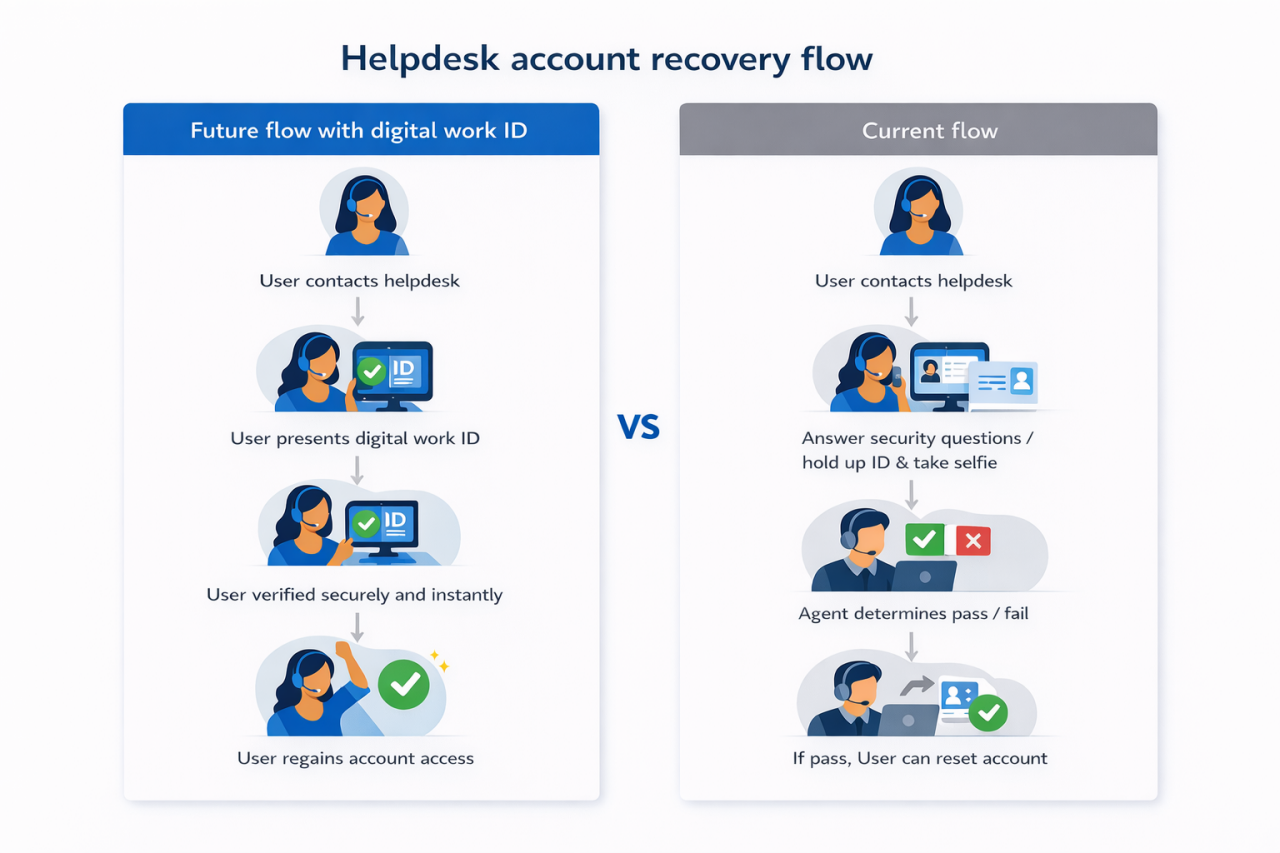
Today, the answer too often relies on manual, fragile methods — knowledge-based questions over Zoom calls, emails from managers, or screenshots of physical badges. All approaches are slow, expensive, and with the rise of AI and generative deepfakes, significantly more vulnerable to sophisticated social engineering. Additionally, the necessity to share more information than necessary creates privacy concerns during what can be stressful moments.
As the workforce becomes more distributed, mobile, and contingent, businesses need a better way to verify employment or work identity.
The opportunity: modernizing work identity
Enterprises need a tamper-proof, privacy-preserving digital employment credential that is resistant to AI and deepfake vulnerability — and they need it now.
Okta secures AI — and every other identity, from machine to human — and is uniquely positioned to make this a reality. As a trusted identity platform serving tens of millions of employees across more than 19,000 customers worldwide, Okta sits at the center of how people access technology at work. That reach gives us a rare opportunity: to help standardize how employment itself is verified, not just within a single application or directory, but across the modern enterprise.
Work IDs are a form of digital employment identity, designed to become a new layer of workforce trust — one that reduces security risk, improves the employee experience, and removes unnecessary friction from everyday IT operations.
What are work IDs?
Digital work IDs are verifiable digital credentials (VDCs) that represent employment and work-related attributes and stored on an employee’s smartphone in a digital wallet of their choosing. Unlike confirming knowledge based directory attributes or verifying physical badges over Zoom, work IDs are cryptographically verifiable (read: AI cannot spoof cryptographic signatures) and portable. They can include verified attributes such as:
- Personal details, like name and identity
- Employment status, including current or past employment, role, or tenure
- Skills and qualifications, such as professional certifications or credentials
These credentials are issued by the employer, stored by the employee in a digital wallet, and presented only when needed. Verification happens instantly, without requiring the verifier to contact HR systems or expose unnecessary personal data.
Work IDs are built on open standards for verifiable digital credentials, enabling trusted, interoperable proof of employment that can be securely shared across applications and services (see Okta’s business value use cases).
Okta’s vision
Okta’s vision is to empower every employee with a secure, portable, and universally trusted digital identity for the workplace, or anywhere employment verification is needed.
Digital work IDs are designed to:
- Be stored in any digital wallet, not locked into a single app
- Give employees control over what they share, and with whom
- Integrate seamlessly into existing enterprise workflows and beyond (ex. Car rentals, apply for a loan, etc.)
Just as identity has become the control plane for access, work IDs are intended to become a foundational control for verifying who someone is at work — across systems, organizations, and trust boundaries.
Why work IDs matter for CISOs and IT leaders
We’ve covered why the future of security depends on verifiable identity. For security and IT teams, work IDs address three persistent challenges:
Enhanced security and efficiency
Work IDs replace manual, inconsistent verification processes with cryptographic proof. Instead of relying on knowledge-based questions or human judgment, helpdesk agents and systems can verify employment status with high assurance. This significantly raises the bar against impersonation and social engineering attacks.
Better user experience
Employees don’t need to install yet another app or remember another process. Work IDs can be presented from wallets they already use, making identity verification faster and less stressful — especially during account recovery scenarios.
Reduced operating friction
By standardizing verification, work IDs reduce escalations, shorten ticket resolution times, and lower support costs. The same credential can be reused across many workflows, eliminating one-off checks and custom processes.
Core enterprise use cases for work IDs
First-party (internal) use cases
Helpdesk verification
When employees contact the helpdesk to reset passwords, recover MFA, or regain access, work IDs provide a high-confidence way to verify employment — without relying on easily spoofed information.
Self-service account recovery
Work IDs enable secure recovery flows that don’t require agent involvement, reducing both risk and operational burden while improving time to resolution.
Device provisioning verification
Before enrolling a new device, IT can verify that the person requesting access is a legitimate employee, helping prevent unauthorized device enrollment.
Privileged access and step-up verification
For sensitive actions — such as elevating privileges or modifying recovery factors — work IDs provide an additional layer of human assurance beyond MFA alone.
Stress-free physical access
When badges are lost or replaced, work IDs can serve as secure proof of employment without manual checks or paperwork.
Multi-party (external) use cases
Cross-company collaboration
In partner and ecosystem scenarios, work IDs enable organizations to verify employment across company boundaries without creating duplicate identities.
Contingent worker onboarding
Contractors and vendors can be issued time-bound work IDs that simplify onboarding while reducing the risk of orphaned access.
Employee benefits access
Work IDs allow employees to prove active employment status to benefits providers without exposing unnecessary personal data.
Onboarding to a new employer
Portable employment credentials can help streamline transitions, enabling faster onboarding and reducing redundant verification steps.
What’s ahead
Work IDs are more than a solution to help desk verification. They represent a new foundation of workforce trust — underpinning access, collaboration, compliance, and workforce lifecycle automation.
Okta is heavily investing in work IDs and verifiable digital credentials (VDCs) more broadly. In January 2026 Okta launched the limited availability of Okta Digital ID Verification Beta — a new capability to help organizations verify government-issued VDCs, starting with mobile driver’s licenses (mDLs). Read the beta announcement to learn more about the beta program and get in touch if you’re interested in participating.
To stay current with what’s new and updated in this space, sign up for updates.


