




Digital transformation doesn’t exactly have a reputation for speed. But at Okta, what began as a few small steps toward supercharging our AI strategy quickly turned into a full-on sprint.
Over the past year, Okta’s AI strategy has focused on investing in tooling and employees with the goal of unlocking new business value and building a more AI-proficient workforce. This involved getting AI tools and features into the hands of every employee and using them as a strategic lever — alongside other, more-traditional automation technologies — to drive efficiency. The impact on efficiency has been swift and measurable: more than 300,000 work hours saved by AI and automation in the span of six months.

A combination of intentionality, ambition, and investing in both the tools and the people behind them has changed the way Okta works. Now, we’re sharing what we’ve learned along the way to help other business leaders navigate their own AI transformation journeys.
Designing the AI adoption blueprint
The journey began with an ambitious goal set by Okta leadership to save the company 250,000 work hours via AI and automation. But Okta couldn’t just open access to all the AI tools.
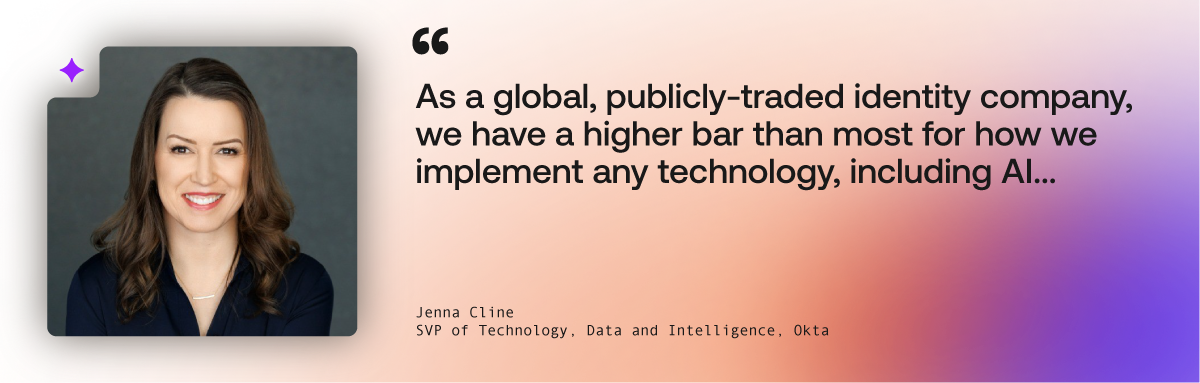
"As a global, publicly-traded identity company, we have a higher bar than most for how we implement any technology, including AI,” says Jenna Cline, SVP of Technology, Data and Intelligence (TDI) at Okta. “We meticulously evaluate every layer — from the technology and data to the people and processes behind them — in order to effectively balance our pursuit of innovation with our needs for security and trust."
Okta established an AI Governance Team to set guardrails that would let innovation thrive without compromising security or user experience. The governance team was tasked with setting criteria and auditable approval processes — both for the broader AI employee toolset and for the technologies being explored within the different business units — that would let innovation thrive without compromising security or user experience.
In early 2025, Okta chose to kickstart its journey by launching Google Gemini and Zoom AI Companion for all employees. Before the launch, TDI was already experimenting with AI and automations, and several proofs of concept were running across the company with AI tools.
“Standardizing on these AI solutions was an easy choice — they are two of our most important and widely-used productivity tools for the majority of our employees. Plus, they meet Okta’s strict security guidelines and check our compliance and risk boxes,” explains Cline. “It was a no-brainer.”
The next step was analyzing the biggest business problem spaces – and which could contribute the most value in reaching the original 250,000-hour automation and AI goal.
Mallika Kumar, Director, AI Strategy and Operations at Okta, says that business leaders should solve for high-frequency friction — the repetitive, manual tasks that drain the energy of their sales, support, or engineering teams — so they can focus on higher value tasks such as building products and meeting customers.
“We went through a rigorous prioritization exercise where we evaluated all AI initiatives on value generated and business readiness, which is how we picked the most transformational projects at Okta,” she says.
An example of this is Project Naboo, an AI project focused on driving efficiency with Okta’s Technical Support Engineers (TSEs). The project, which initially launched to a small subset of TSEs in Nov. 2024, was designed to help TSEs find information, automate responses, and troubleshoot issues. Recognizing its potential, in the ensuing months, Okta continued to improve, iterate, and launch enhancements to Naboo while expanding its user base to more TSEs. Naboo is estimated to save Okta more than 85,000 hours each year. In addition, the support cases leveraging Naboo consistently have higher customer satisfaction and lower dissatisfaction scores compared to the previous fiscal year, and there has been a roughly 25% decrease in time spent with Okta support across low- and medium-complexity issues.
By the end of the fiscal year in January, Naboo and the other prioritized projects ended up saving Okta more than 300,000 hours – surpassing the initial goal of 250,000. This number excludes savings from productivity apps like Gemini.
Building an AI-ready workforce
Okta launched Gemini Chat in March of 2025, and Gemini for Google Workspace and Zoom AI Companion a month later.
The ensuing months featured a number of initiatives meant to upskill the workforce and empower them to use AI. Among these efforts were ‘AI Days’, when employees were encouraged to experiment with AI tools, and ‘Promptober’, where employees were tasked with designing a prompt for Gemini and rewarded for completing the challenge. The company also launched ‘The Hacker's Guide to the AI Galaxy’, a company-wide hackathon.

“Just giving people AI tools isn't enough; you also need to build a foundation of AI literacy,” says Kumar. “Committing to programs such as AI Days is signaling to your employees that we at Okta are investing in them, not just in the software. And by providing employees with dedicated time blocks to complete trainings or AI Days, we're also removing friction by giving them permission to stop their daily work and actually see how AI can help them with their work."
How security helped shape the rollout
A focus on security underpinned the effort, helping build a program that could scale safely and creating a culture where employees knew how to use AI responsibly.
“The Security team partnered closely with TDI to deliver messaging, guidance, and training on the use of AI tools, particularly for the internal rollout of Google Gemini,” says Tom Ross, Director, Security Governance at Okta. “We co-developed training on how and what data can be shared with Gemini, how the tool should and should not be used, and what the ethical expectations are related to vetting and representing the output of prompts and Gems.”
The most challenging aspect, says Ross, was integrating net-new workflows into our existing software procurement and onboarding processes.
“If someone wants a new AI tool, do they come to the AI governance team first, or do they contact Procurement first? If a vendor has received a clean risk assessment report, how does that relate to their new AI offering? What happens when someone wants to use an existing AI tool in a new way — like sharing sensitive data or analyzing proprietary code? Ultimately, a new workflow — and a new employee portal — was required to bring all the different threads together into a single, easy-to-use, and effective workflow,” Ross says.
From risky use to approved pathways
Employees using shadow AI was a general concern, but it has evolved over time to include not just people using unapproved tools, but people using approved tools in unauthorized ways. Significant effort has been made to provide “paved paths” for the Okta workforce to follow, depending on their particular AI-related use case. These include preconfigured and implemented tools, as well as integrated AI functionality in existing tools, Ross explains.

“Third-party vendors offering outsourced AI features represent a fourth-party concern, which is something that required a relatively fast pivot to stay in front of,” he adds. “It was no longer good enough to say that a specific vendor was approved; we also had to know more about their AI agent. There were instances of approved vendors using prohibited AI services, which adds considerable complexity to the overall process.”
A million-hour goal and the mindset to reach it
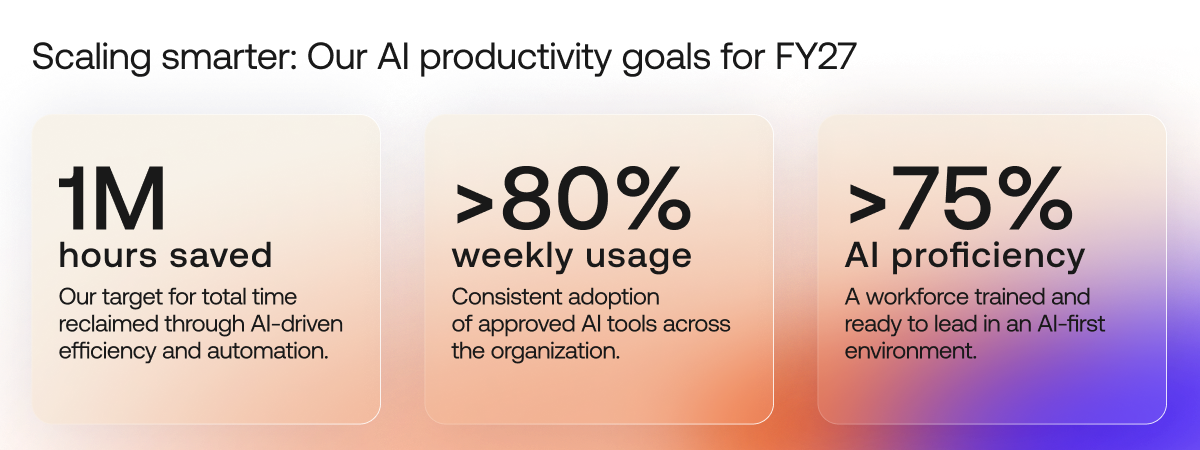
For fiscal year 2027, there will be an increased focus on using AI to increase individual productivity. The target is to save 1 million work hours through AI and automation and achieve over 80% weekly usage of approved AI tools and agents. Another goal is to have at least 75% of employees be AI proficient by the end of FY27.
Rather than blocking innovation, the focus remains on enablement. At Okta, experimentation triggers rapid learning. By encouraging pilot programs, the company can quickly identify what works, what doesn’t, and where to invest. For example, the company simultaneously tested two AI support pilots before choosing the solution that met Okta’s standards for performance and security.
“Our philosophy of AI innovation is two-fold. First, we need to establish ‘paved paths’ – vetted, secure sets of tools, data, and/or processes that enable the majority of employees to feel confident in experimenting with AI,” says Cline. “Second, we need to invest in technical teams that can explore Okta’s most complex opportunities. I’m proud to say that we’re doing both.”
As always, success is not just about tools and technology; it is also about people. In the second part of this series, Okta will discuss how its internal education and training initiatives helped create a more productive, AI-friendly workforce.


