




Executive summary
Managing enterprise AI agent identity internally quickly scales into a continuous governance and compliance burden. It requires centralizing authentication, authorization, token lifecycle management, and audit logging across all internal, third-party, and shadow agents. Building a custom access layer leads to security blind spots, compliance failure during audits, and continuous engineering overhead as MCP and OAuth specifications evolve.
Investing in a centralized agent identity layer allows enterprises to decouple tool access from credential management while helping enable continuous auditability and Zero-Trust security—and keeps your engineers focused on developing the agents that help you execute business-critical work.
What is an AI agent identity layer and how is it built?
When AI agents began taking action rather than just answering questions, platform teams had to connect them to real tools and data quickly. Many teams ended up building an access layer themselves, which usually has three primary components:
- A Model Context Protocol (MCP) gateway that routes agent traffic to MCP servers
- A token broker that holds and refreshes each user's credentials for the SaaS apps agents call
- Role-based scope filtering that limits which tools an agent can use based on the user's role
Those builds took months of engineering work, brought agents into production, and kept credentials out of prompts. For most teams, building was the only option at the time.
Download our AI Agent Identity: Build vs. Buy whitepaper to learn why purchasing a purpose-built identity layer is the most effective way to manage AI agents across their full lifecycle—without burying your engineering team in open-ended identity maintenance.
The six critical identity questions for enterprise AI agents
As agent adoption grows and agents take on more business-critical work, teams are finding they need to answer more questions:
- Agent identity: Who is each agent?
- Ownership: Who owns the agent?
- Delegation: On whose behalf is the agent acting?
- Scope: What tools and resources can it reach?
- Audit trail: What specific actions has it taken?
- Kill switch: How do teams rapidly revoke access or shut it off?
How the scope grows
The first version of building an agent access layer is manageable. One team builds a handful of agents, gives each one a service identity, stores users' SaaS tokens in a broker, and keeps a list of which agents exist and who built them. For a single team whose agents stay inside its own platform, that design holds up well.
Then, the agent population and the business needs keep growing. Each new SaaS app your agents access runs its own authorization server with its own consent model, token lifetimes, and revocation behavior, so the broker needs an additional integration. Other teams start shipping agents on their own schedules, and some never route through the layer your platform team built.
Developers run coding agents like Claude Code, Codex, and Cursor on their laptops, and those agents connect directly to MCP servers and code repositories by pasting tokens into a local config file, because they never pass through the central build. Agents on vendor platforms reach your data through the vendor's own connectors. Embedded agents, agent swarms, and local models each expose new gaps, and every new integration adds load to an identity stack that more critical workflows now depend on.
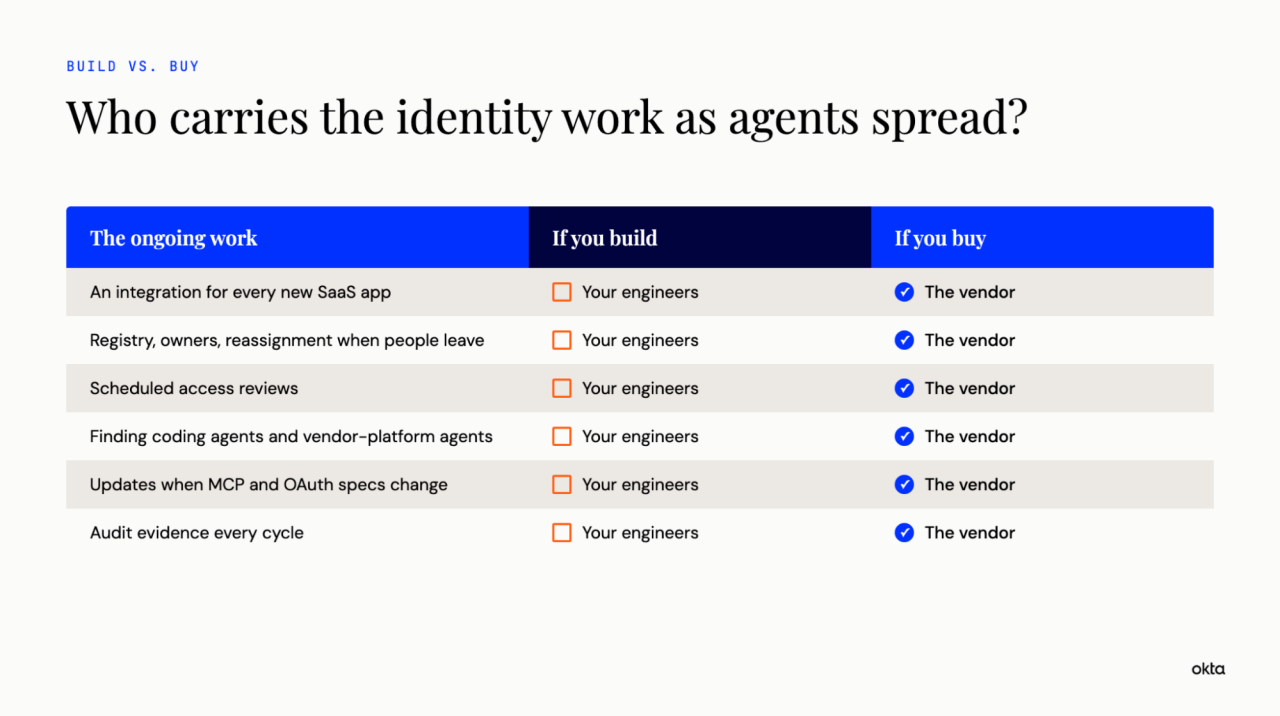
By then, the team that built an access layer for its own agents is running an identity product for the rest of the company.
Managing your own identity governance means audit season never ends
Many organizations start with a simple agent registry: a list of each agent, who owns it, and the tools and apps it can reach. It stops working when other teams ship agents, owners change roles or leave the company, and auditors ask for evidence that someone reviewed each agent's access this quarter.
That evidence rarely lives in one place. The gateway logs one thing, the broker logs another, and the SaaS apps the agent reached log a third, so proving what happened means pulling records from each system and correlating them manually.
To actually scale agents, most teams find the registry has to do more too: reassign or retire agents whose owners are gone, run access certifications on a schedule, and show who authorized an action, for whom, and under what policy, months after it happened. That work repeats every audit cycle and grows with every agent your organization adds.
OWASP ranks agent identity and privilege abuse No. 3 among the top risks for agentic applications, citing unclear ownership, inherited credentials, and cached tokens. These are exactly the gaps that open as a homegrown registry stretches.
MCP and OAuth security standards keep moving
The standards for agent authorization are still being written. Within the last 12 months, we’ve seen major shifts in the guidance:
| Date | Specification/regulatory update |
|---|---|
| June 2025 | The Model Context Protocol authorization specification adopted OAuth 2.1 and prohibited passing a client's token through to downstream APIs. |
| September 2025 | The IETF OAuth Working Group adopted the Identity Assertion Authorization Grant, which serves as the basis for delegating access from an enterprise identity provider to third-party apps. |
| July 2026 | The MCP specification began requiring authorization-server issuer validation and moved client registration to client ID metadata documents. |
Additionally, NSA guidance on MCP security notes that the protocol leaves token refresh and revocation unspecified, so every team that builds its own layer has to design and defend those behaviors itself.
Each specification change means someone reads the new spec, updates code, and retests.
Why homegrown token brokers fail at enterprise SaaS authorization
A homegrown broker can hold and refresh tokens that SaaS apps have already issued, but it can't grant access on its own authority. Each SaaS app decides which identity providers it trusts to vouch for your users, and app vendors build that trust for a short list of established identity providers. If a broker one company runs internally isn't on that list, every new app means another round of per-user consent screens or manual admin grants.
Cross App Access works differently. Your identity provider grants the agent scoped access directly, so IT sets the policy once, users skip the consent screen, and access control is centralized. A growing number of SaaS apps support it, and the Model Context Protocol adopted the same pattern as enterprise-managed authorization.
Build vs. buy: Shifting engineering velocity to core business needs
The value of an agent comes from what it does for the business: the workflow it automates, the data it brings together, and the decisions it speeds up. Every hour your engineers spend maintaining token refresh logic, rebuilding consent flows for the next SaaS app, or producing access-review reports for auditors is an hour they don't spend on the agents themselves.
Most platform engineers would rather build agent capabilities than run an identity service.
Keep what you built, buy what's underneath
The access layers teams built for their first agents solved an urgent problem. The identity layer underneath is a different commitment. It has to cover every agent in the enterprise, including ones your team never built, reach apps your organization doesn't control, keep up with standards that are still changing, and produce audit evidence every cycle for as long as agents run.
Investing in a security layer keeps your engineers focused on the agents that drive the business, gives security and IT teams one place to see and control agents, and shifts the ongoing work of managing standards, integrations, and governance to a team whose only job is identity.
Okta® for AI Agents is an agent identity layer that works alongside the identity provider and gateways you already run. It answers four vital questions about your entire agentic fleet:
- Where are my agents? Discovery and registration
- What can they do? Scope and entitlement management
- What are they doing? Unified audit logging
- How do I respond? Automated revocation and threat isolation
Buyer’s guide: Technical breakdown and security review framework
For the full analysis, including the questions to ask any identity vendor in your security review, read the AI Agent Identity: Build vs. Buy whitepaper.
These materials are for general informational purposes only and do not constitute legal, privacy, security, compliance, or business advice.
The content may not reflect the most current security, legal and/or privacy developments. You are solely responsible for obtaining advice from your own legal and/or professional advisor and should not rely on these materials for compliance, implementation, or purchasing decisions.
Okta makes no representations or warranties regarding this content and is not liable for any loss or damages resulting from your implementation of these recommendations. Information on Okta’s contractual assurances to its customers may be found at okta.com/agreements.


