




The room smelled faintly of new plastic. It was 7 a.m. in a boardroom a few minutes from the gates of Legoland in Malaysia, and I was sitting at a desk with a name tag on and a notebook I no longer quite knew how to use. It had been 12 years since I was last in a classroom setup like this.
I’d flown in to spend a week getting certified in the LEGO® SERIOUS PLAY® facilitation methods. But sitting there with a dry mouth and a belly full of butterflies, trading careful hellos with 14 strangers from around the world, the first thing I noticed wasn’t the method. It was me. I had almost forgotten what it feels like to be a student in a real classroom setup.
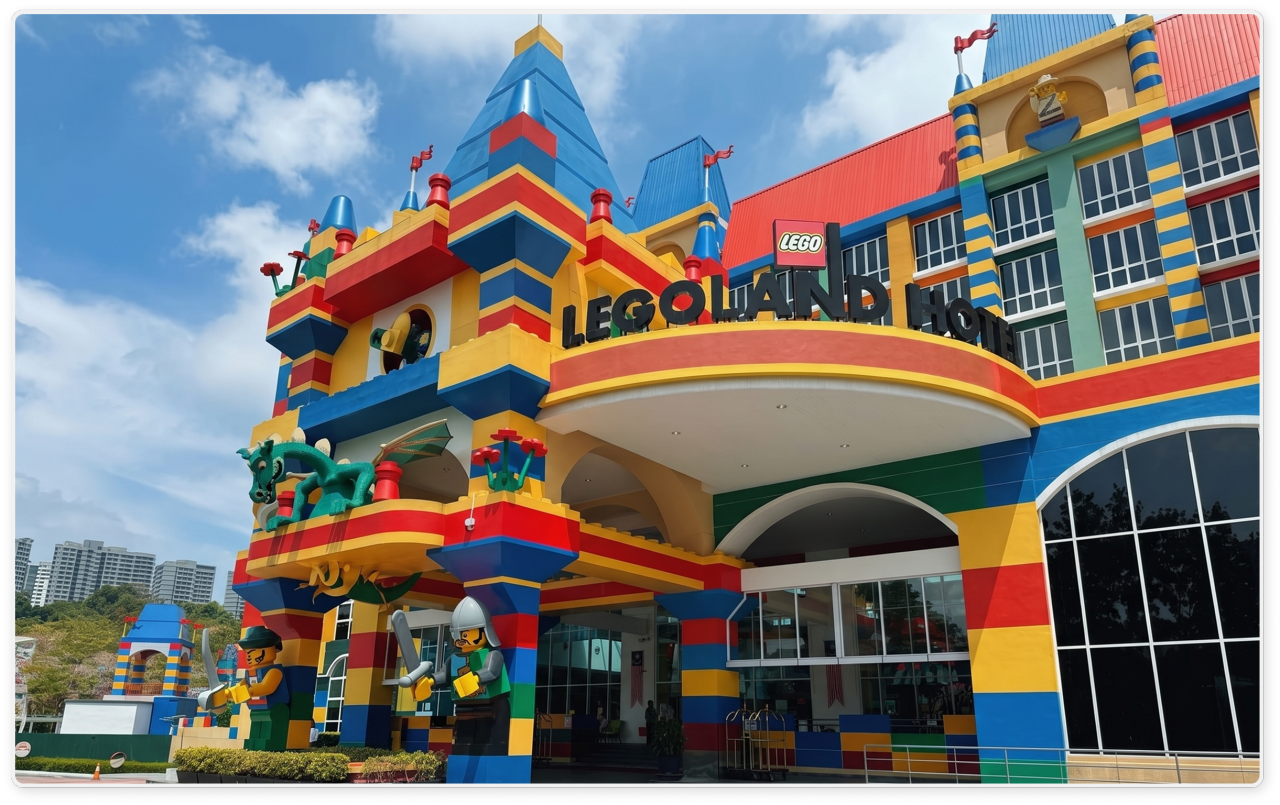 Walking in, I never imagined a place this playful from the outside would hand me a lesson I’d keep for life.
In the year when everyone else was chasing AI, what I went looking for instead
Here’s the part I should be honest about: I use AI heavily, every single day. I didn’t go looking for a box of bricks because I fear where AI tools are headed; I went looking because I lean on them so much.
When AI is in everything you do, you start to notice what it quietly costs you—not your job, but your attention. It’s the muscle of sitting with a hard question long enough for an honest answer to surface. I’d watched teams move faster than ever and, somewhere in all that speed, stop thinking together.
The problem was never execution; it was unquestioned execution. So I went looking for the opposite of speed—something that intentionally slows people down and forces them to externalize what they actually think. I’ve come to believe that protecting that muscle in myself and in the people I lead is part of the job now. That’s the hypothesis I got on the plane to test.
Strategic imagination: Learning to think with your hands
The first morning was the hardest thing about the whole week.
Going back to a classroom after 12 years, I was sure I’d be slow, too out of practice to keep up with a full day of listening, making notes, speaking, and thinking out loud. By the afternoon, I realized the opposite was true.
Twelve years of work had taught me how to learn. By day two, I wasn’t just surviving in the room—rather, I was leading discussions and enjoying myself more than I had in a long while.
It turns out being a student is one of my favorite things to be. I’d just forgotten.
The paradox of strategic imagination
One phrase from the trainer has stayed with me since. We were talking through what these methods even are, and he called it strategic imagination. It sounded like a contradiction. Because until then, I thought that imagination is supposed to run free, whereas strategy is supposed to fence it in. But that week proved the opposite.
Imagination, when guided by intent, doesn’t get smaller; it gets pointed at the right thing. I realized that the whole craft lies in facilitating and holding the room so that what people imagine actually becomes useful.
Why your hands work faster than your mouth
The methods themselves are deceptively simple. You give people bricks, ask them questions, and you make them build the answer before they’re allowed to explain it. The trainer had a refrain for it: “Think with your hands.” Build first, talk second.
With practical application, he taught us that our hands work out what our mouths haven’t figured out yet, and what we build is almost always more honest than what we would’ve said. And because everyone builds, everyone contributes. It doesn’t matter if you have four people in the room or 400; it runs the same.
We learned how to use it for the kind of work a slide deck tends to flatten: Strategy, values, and a vision. Today, I can confidently use these methods to help leaders define strategy, surface what any group actually values, and commit to a vision.
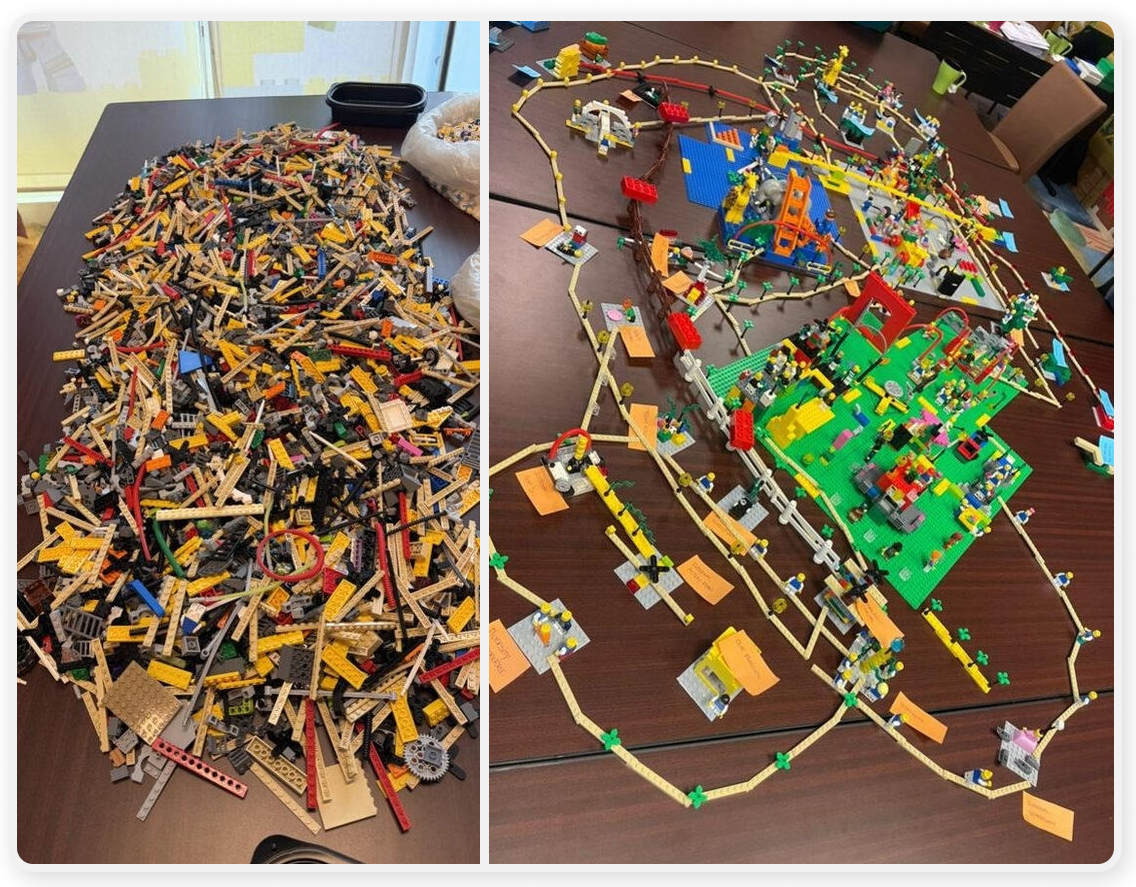 Two days, one table: From a heap of loose bricks to the world of metaphors we built.
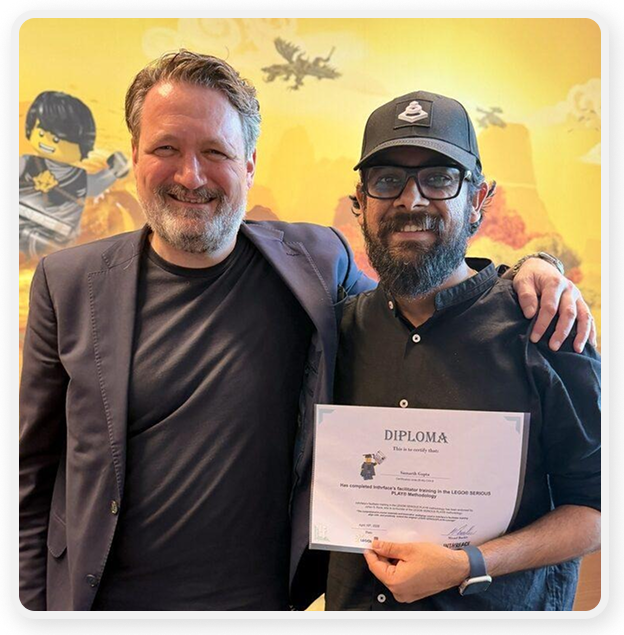 Diploma in hand, with my trainer. Back to being a student, 12 years on!
Same bricks, different ducks: One problem, 170 solutions
I didn’t want the week’s learnings to remain a controlled experiment in my head. I wanted to try it somewhere real, with stakes, strangers, and constraints. Two weeks after I landed back in India, I got the chance. We—the design team at Okta India—were hosting an evening with Friends of Figma and around 170 designers and builders.
We planned it as an afternoon of talks on AI, agents, identity for a world of non-human users, and Figma’s vision for AI in product development. A genuinely good lineup. Also, by design, a full one. Then, 36 hours out, it started to come apart.
One of our headline speakers was due to fly in, but was grounded by an emergency. The next morning, hours before doors opened, another speaker had to pull out. We had been selling this lineup in the weeks leading up to the event, and right before it was about to start, we’d just lost a chunk of it.
For a moment, it felt like we’d be betraying the people who signed up. But the show went on, because that’s what shows do. Colleagues rearranged their evening to backfill the gaps, and the scramble opened a door for something I’d been holding in my back pocket: A 10-minute LEGO® SERIOUS PLAY® activity I’d planned as an optional filler while the room would reset for the panel discussion.
To pull it off, I had cold-emailed LEGO India weeks earlier, found my way to their India distributor, and we’d improvised a set of eight bricks each—five yellow, two blue, and one orange—for nearly 200 people. We received more than 1,500 bricks. Our team helped tuck them quietly into everyone’s swag boxes, with the intent that if we made it to the activity, we’d tell them; otherwise, they would simply keep it as a souvenir.
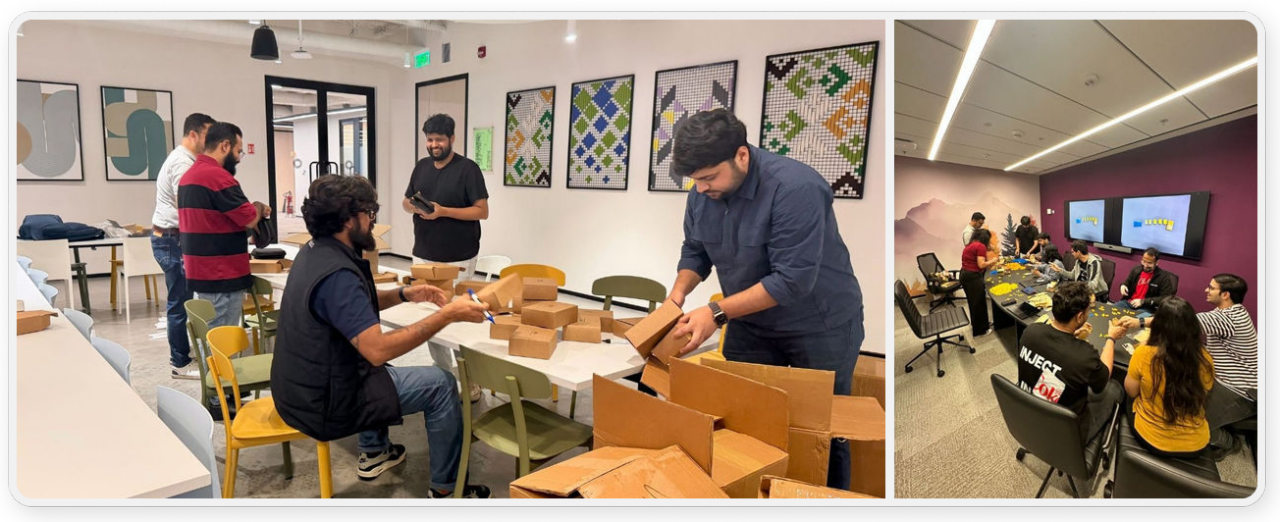 The unglamorous behind-the-scenes: Because 1,500 bricks don’t pack themselves. The team made the magic possible by packing and then tucking them into the swag kits.
The only instruction that mattered: Build a duck
When the moment came, I asked the room to open their boxes and look for a tiny bag of eight LEGO bricks, but not to build anything yet. I told them they'd just spent 90 minutes hearing how fast everything is changing, and I wasn't going to add to it—rather, I’d show them something about themselves and not the tools. At that moment, everyone was clueless!
Then, brought in the only instruction that mattered: “Using only what’s in front of you, build a duck.” Two minutes. In silence. No looking at your neighbor’s. No right answer.
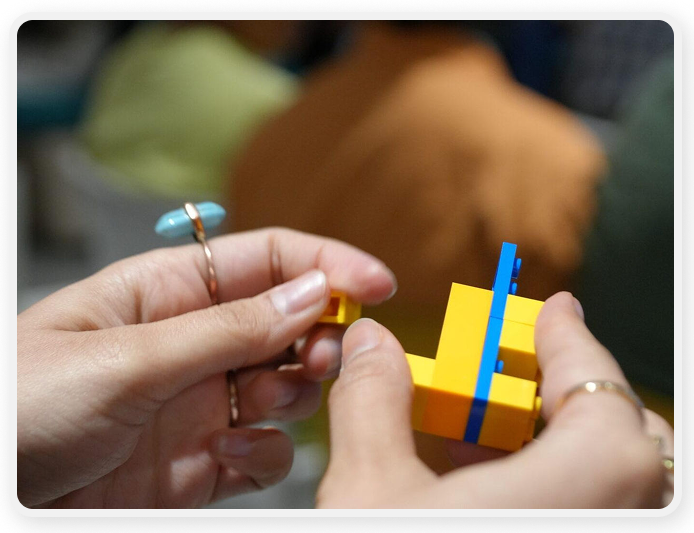
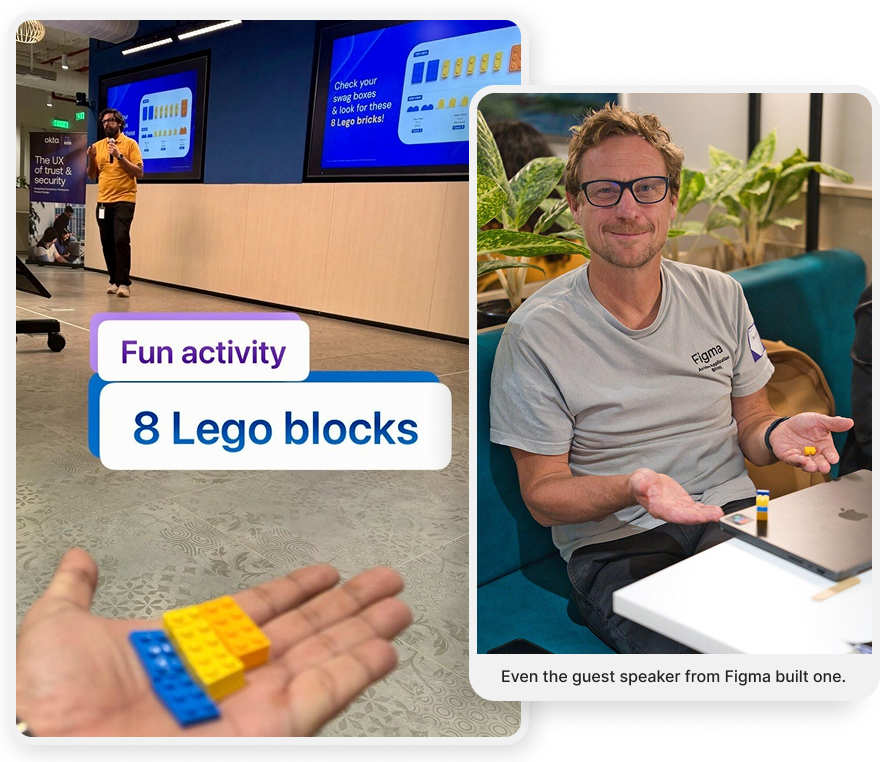 Eight bricks. Five yellow, two blue, and one orange. Two minutes and no instructions.
What happened next was the whole point of the activity. Same bricks. Same prompt. Same two minutes. And not one duck was the same as another. Nobody was exempt.
The difference between the average and the specific
I picked two people with wildly different ducks and asked each of them: “What did you build? Why that way?” Same eight bricks, completely different logic.
Then I named it. Same input, same constraints, yet every output is different. Not because some of us are more creative, but because every mind processes the world differently.
AI is trained to give the most probable answer, the center of the bell curve. What they’d just built was nowhere near it.
AI works on averages. You work on specifics. That gap is your entire job!
I told them to keep the bricks—not as souvenirs, but rather for the next time an AI hands them an answer and they’re not sure if it’s the right one. They should just pick one of these bricks up. It’ll remind them of this day, along with the fact that the judgment lives within you and not the model.
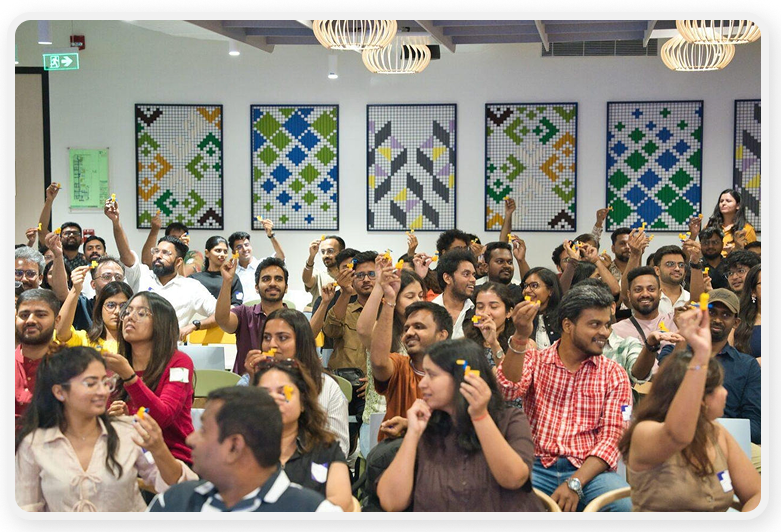 “Hold up your creations,” I said. Around 170 of them filled the room. Same eight bricks, no two alike.
The event was scheduled to end at 7:30 p.m. It was 9 p.m., and people were still deep in conversations! The next morning, my phone wouldn’t settle. The LinkedIn recaps started rolling in, and nearly every one of them mentioned the LEGO duck.
“Same problem, many solutions,” one designer wrote. “AI can accelerate execution, but it can’t replace judgment,” said another. “AI can take care of the execution layer—your brain is your ultimate asset.” They were handing my own thesis back to me, in their own words. The bricks had done the arguing.
What it taught me about teams, and about staying a learner
The craft lesson
The skill that matters more than ever now isn’t prompting, and it isn’t speed. It’s judgment, the conviction to look at outputs and say: “This one, not that one.” AI can easily hand you a hundred plausible answers. Knowing which is right is still entirely yours. The LEGO activity just made it impossible to forget.
The facilitation lesson
The leaders who’ll matter most over the next few years aren’t the ones who just help their teams produce faster. They’ll be the ones who protect time for their teams to think, who can hold a room, ask the loaded question, and sit in the silence while real answers surface.
And quietly, underneath both, a week of being a beginner again gave me something 12 years of being the expert had misplaced. The point was never the credentials. It was a reminder that the most useful thing any leader could do for their craft and for their teams was to keep choosing to learn.
One more thing
I got to run this experiment because I work in an organization that treats a 10-minute LEGO activity as a bet worth making, with a safety net in case it fails. That’s rarer than it sounds, and I don’t take it for granted.
I’d suggest that if you’re a fellow learner at heart, try to find your version of the desk you haven’t sat at in years. Then put what you learn in front of a room that will test it. The bricks are optional. The thinking isn’t!


