




Launching an AI initiative is a technical milestone, but driving company-wide AI adoption is an organizational transformation. It’s a fundamental shift Okta knows firsthand.
In part one of our AI transformation story, we showcased how we scaled AI and automation across the business to save more than 300,000 work hours in the span of six months. Even as new tools rolled out, Okta never lost sight of building an AI-proficient workforce that felt confident to experiment with AI to solve real business problems.
But what does this look like in practice? For anyone in the midst of an AI transformation, read on to learn about our ongoing efforts to educate and upskill our employees with training, internal comms, and organizational support—and how you can do the same.
Building an internal network of AI Change Champions
In the spring of 2025, Okta kicked its AI plans into high gear. Following the company-wide launch of Gemini for Google Workspace and Zoom AI Companion in April, internal discussions about developing a more scalable way to roll out AI programs, messaging, and announcements intensified.
As part of this growing momentum, the AI Strategy Team, led by Deepti Arora, VP, AI Strategy at Okta, took the lead in developing several initiatives. One of these was to build a network of advocates: troops on the ground from across the company who could promote strategic AI goals. After a selection process, the “AI Change Champions” were born.

As liaisons between the AI Strategy Team and their respective business units, they drive AI fluency and engagement within those units, and accelerate adoption by providing peer support, says Cyndi Walker, AI Culture and Change Senior Manager at Okta.
The approach yielded immediate results: “We hit over 93% completion rate on the Okta AI Bootcamp training, and the Change Champions were one of our central messaging teams for that initiative,” Walker says. “Currently, we're working on rolling out monthly enablement kits, and the Change Champions are being tapped to help provide assistance to managers to facilitate those workshops and to help customize those kits so that they're relevant within the business unit.”

The first of those kits guides employees in building their own custom AI assistants, or “agents,” in Open WebUI. A more recent kit is focused on generating code using Claude AI models, all accessed securely through our LiteLLM gateway, says Walker.
Game on: Developing AI skills (and having fun)
In October 2025, Okta launched a series of employee education initiatives, including “AI Days,” which focused on dismantling some of the fear around AI and encouraging employees to experiment with it, remembers Jenna Isherwood, Senior Director, Company Planning and Programs at Okta. In general, AI Days consisted of teaching a model, a demo, and a workshop.
“This AI wave came on pretty quickly, and we had a hefty goal around AI fluency and getting every ‘Oktanaut’ using our AI tools,” she says. “We had a survey after each one to see how it resonated with the audience, and quickly found that folks love the hands-on elements and essentially wanted more.”
Another effort was “Promptober:” Employees were challenged each day during October to build prompts using Gemini. A tool scanned the response to validate they met the day’s requirements. Those who completed the challenge successfully received a small financial reward.
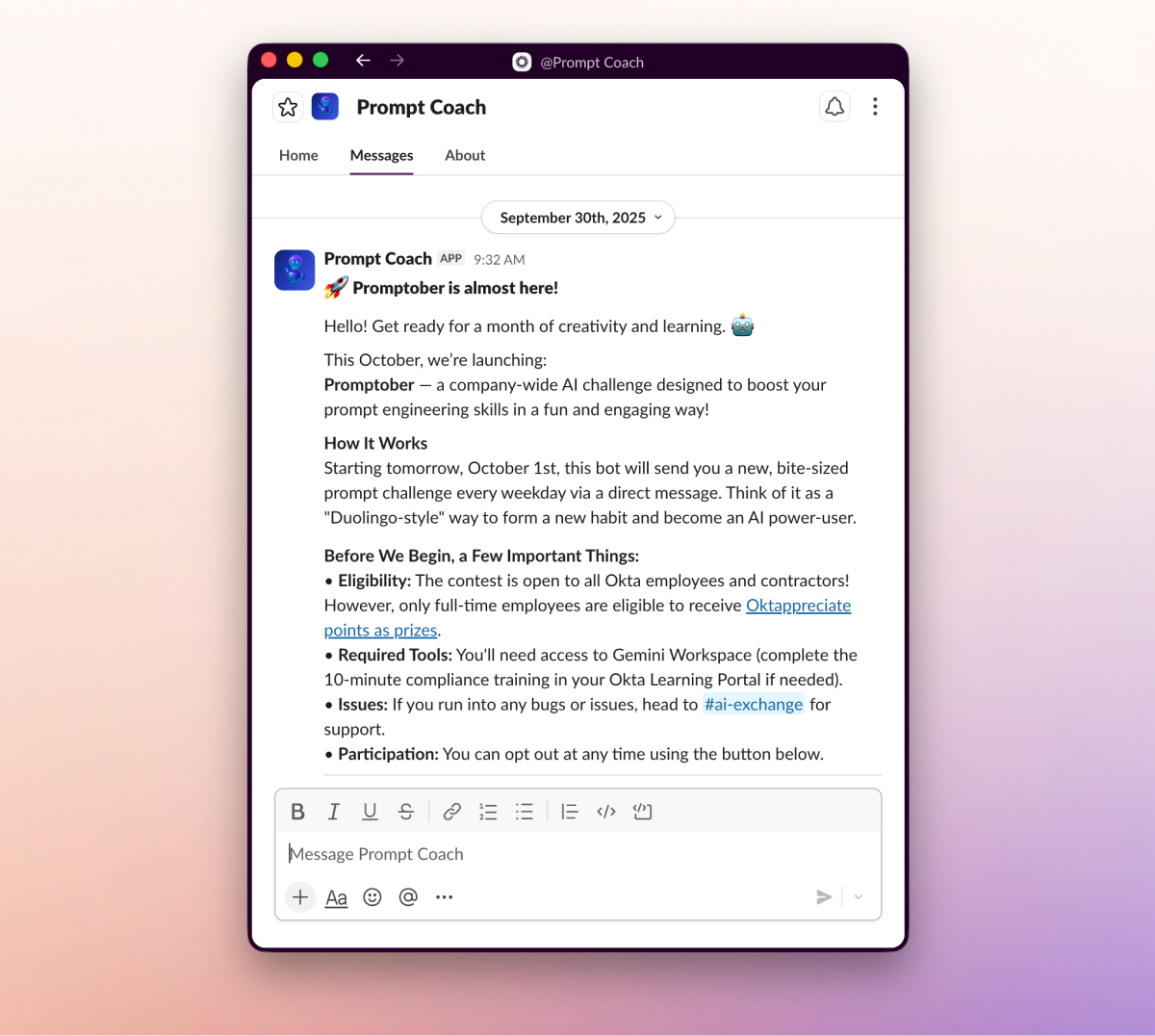
“Promptober was about empowering our employees to move beyond basic questions and strategically engage with AI. We’re teaching them how to craft prompts that deliver precise, actionable responses, ultimately accelerating their work and driving tangible business results,” Walker says.
Since it was the first internal initiative of its kind, people were initially unsure how much employees would participate, she explains.

“One of our internal business objectives was to achieve 25% of participants reaching a streak of five or more consecutive business days,” she says. “Instead, we hit 36%. So it was another real testament to the stickiness of the tool.”
Empowering employees to experiment
Designing Google Gemini prompts and Gems isn’t the only way Okta employees turned to AI to improve productivity. Open WebUI is central to Okta’s strategy, acting as a secure sandbox where employees can move from passive users to active creators of AI agents in a protected environment. All external AI traffic passes through a unified gateway powered by LiteLLM in Okta’s private cloud, creating a centralized point for security and policy enforcement.

“The system has a block on egressing any data to the outside world,” says Dennis Henry, Productivity Architect within Okta’s Technology, Data, and Intelligence (TDI) team. “Also, for the LLMs specifically, we have (Amazon) Bedrock guardrails.”
Typically, there are more than 1,000 active users of Open WebUI at any given time during the AMER/EMEA time zones, he adds, noting that we now have over 200 custom models/agents built.
“Open WebUI is by far the most well-known and well-supported AI Chat Gateway out there,” explains Henry. “It's a really great solution for our use case.”
This same spirit of experimentation spread to Okta’s annual hackathon, which in 2025 was dubbed “The Hacker's Guide to the AI Galaxy.” When it was over, 1,129 people had participated, an increase of nearly 30% since the last event. The hackathon also featured 400 projects, a more than 22% increase. Fifty-nine of the resulting projects were shared with the patent team.

Ninety-four percent of participants surveyed afterward said they were highly likely to apply the knowledge they gained, especially in AI, to their regular work.
“The goal is to provide Oktanauts with a dedicated space away from day-to-day work to experiment fearlessly, spark creativity, and promote collaboration,” says Jasmine Bent, Principal Enablement Program Manager, Innovation and Special Programs, at Okta. “By partnering with the Take Okta to the power of AI initiative, we’ve integrated additional company initiatives into the event to increase focus on AI skill development and innovation.”
Understanding your starting point
Okta has set a clear goal for fiscal year 2027: at least 75% of employees will be AI proficient by the end of the year.
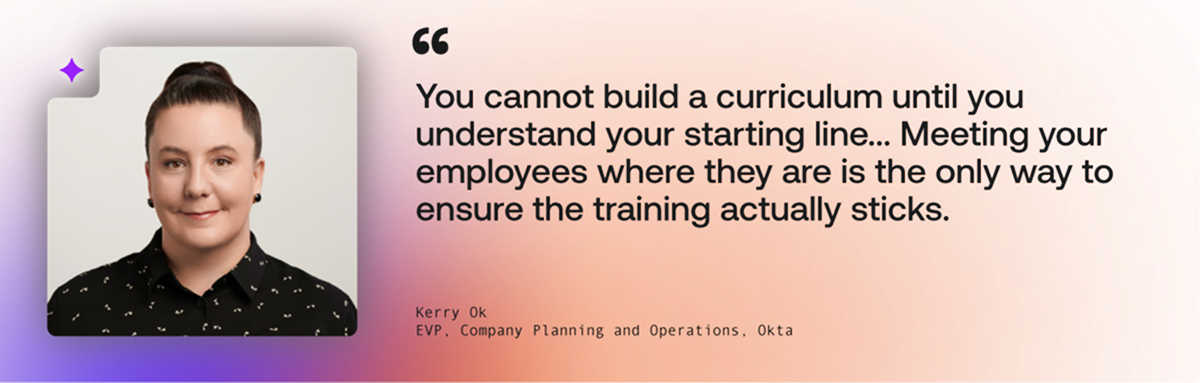
"Scaling education across a global organization requires moving away from a 'one size fits all' mentality,” says Kerry Ok, EVP, Company Planning and Operations at Okta. “The first lesson we learned is that you cannot build a curriculum until you understand your starting line. You must establish a clear benchmark of where your teams currently stand—not just in their technical prowess, but in their sentiment toward using AI. Meeting your employees where they are is the only way to ensure the training actually sticks.”
“Once you have that baseline,” she continued, “the key to engagement is hyper-relevance. Using AI in HR looks fundamentally different than using it in Sales or Software Engineering. To scale successfully, the training must be interactive and highly customized to the specific function and skill level of the employee. If the content doesn't feel immediately applicable to their daily workflow, you aren't just losing their attention—you're losing the opportunity to truly transform your workforce."
She suggests organizations lean into their core competencies and partner for the rest, noting that Okta used a third-party to customize a training tool.
“At Okta, our DNA is identity; we have deep expertise in how AI intersects with security and authentication, but we aren't a training company,” she says, adding that trying to develop custom AI curriculum internally can be slow and ineffective.
“By partnering with an organization whose sole focus is AI workforce education, we were able to move much faster and ensure our teams were learning from the absolute best in the field.”
Looking to the future—and 1 million hours saved
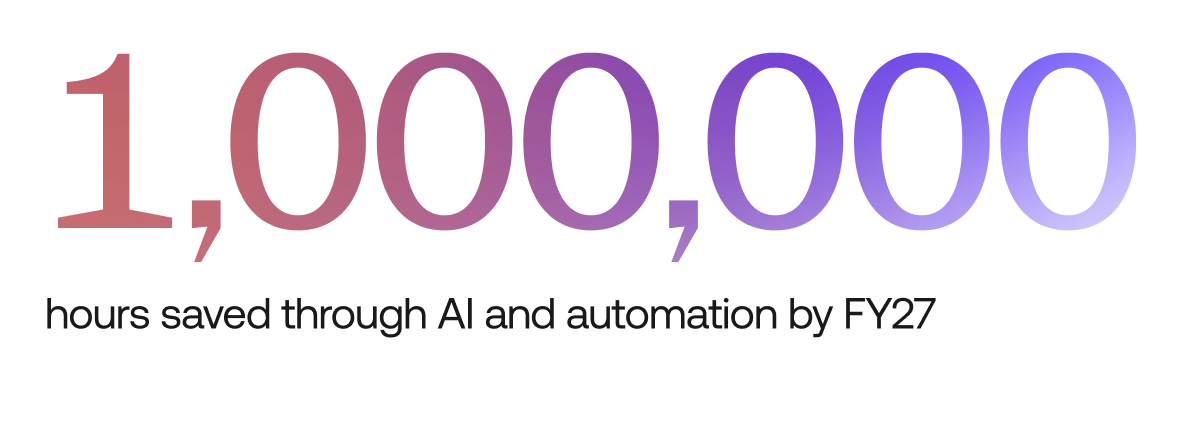
The savings target for fiscal year 2027 is to hit 1 million hours through AI and automation, including personal productivity and business process tools.
“Our focus is on enrolling every employee in this journey, ensuring they are the primary architects of our AI evolution,” says Mallika Kumar, Director, AI Strategy and Operations at Okta. “At its core, AI is about much more than efficiency. It is a catalyst to drive company growth and a powerful vehicle for personal career transformation.”


