


Products
Our platforms secure all types of identity from AI agents to your customers, employees, and partners.
Our platforms secure all types of identity from AI agents to your customers, employees, and partners.
Okta is the neutral, powerful, and extensible platform that puts identity at the heart of your stack.
Okta and Auth0 deliver flexible, secure access. Build fast with our extensible platforms for customers, workforce, and non-human identities.
Our platforms secure all types of identity from AI agents to your customers, employees, and partners.
Our platforms secure all types of identity from AI agents to your customers, employees, and partners.
Okta is the neutral, powerful, and extensible platform that puts identity at the heart of your stack.
Okta and Auth0 deliver flexible, secure access. Build fast with our extensible platforms for customers, workforce, and non-human identities.
Our platforms secure all types of identity from AI agents to your customers, employees, and partners.
All types of organizations struggle to keep up with the increasing pace of change in today’s business environment, especially as remote workforces become more prevalent. At the same time, employee, partner, and customer expectations for frictionless—but still secure— experiences are soaring. Identity and access management platforms play a pivotal role in helping organizations address these demands by getting their end-to-end user lifecycle under control. With powerful automation, you can move from manual employee onboarding and offboarding IT tasks towards a modern approach.
In particular, the Okta Identity Cloud enables many forward-looking IT teams to streamline tedious provisioning, entitlement configuration, and deprovisioning processes. Many of our customers deploy Okta Lifecycle Management (LCM) to stay on top of identity changes via pre-integrated provisioning for 200+ apps, a universal directory with lifecycle awareness, and prescriptive lifecycle orchestration. This gives you the flexibility and agility you’ll need to achieve visionary LCM workflows that not only decrease costs, but increase productivity and improve your security posture as well.
We’ve found that our most successful customers tend to incrementally modernize identity processes in a staged manner over time. In this way, you can quickly realize initial time savings and achieve fast ROI, rather than trying to configure every possible lifecycle management feature all at once. In this whitepaper, we’ll provide a practical framework of best practices, recommendations, and goals for four common stages of lifecycle management maturity:
Over the past decade-plus, Okta’s experts have accumulated thousands of collective years of experience, lessons, and strategies from working with the 8,400+ organizations that rely on our platform as their foundation for identity and access management. Based on those insights, we developed the LCM maturity curve (fig. 1), along with the following detailed guidance. To help you tackle each phase at your own pace, the next section provides key prerequisites and gradual steps you should consider as you advance your approach to automation.
But first, it’s important to understand that no matter how mature your identity strategy is, there are four primary areas of LCM that often confound IT and security teams: managing identity data, identity lifecycle processes, access grants, and audits and compliance.
Managing identity data is all about creating a reliable system of record of all users—primarily your employees, but also contractors, partners, and customers. As such, it’s usually the very first challenge teams face when they kick off a modern identity management initiative. Deploying any identity-related technology, such as single sign-on (SSO), provisioning, or multi-factor authentication (MFA), requires you to establish a single view of all the end users that access your IT ecosystem.
Creating this single view is difficult because it’s fraught with questions like:
More and more, we’re noticing that identity lifecycle decision-making is no longer contained solely within IT. Increasingly, app owners and business unit managers determine who gets access. In addition, many organizations have implemented highly-customized business logic that most solutions can’t handle out-of-the-box. Consequently, IT teams are frequently weighed down by at least some manual identity tasks.
IT and security teams have the opportunity to offload tedious work by not only automating access decisions, but enabling self-service for end users as well. This reduces dependence on IT, and sets you up to securely and consistently grant access as your organization grows. However, it’s becoming more difficult as remote work environments drive up demand for new digital collaboration resources, as well as temporary grants for elevated access.
Most likely, your access management strategy has to accommodate the following business requirements:
Not to be overlooked, the fourth major challenge of effective identity management is managing audits and compliance. While your security team holds responsibility for helping auditors understand who has access to what, IT is often asked to provide that data for them. As you’d expect, the extent of this burden varies greatly across organizations. Some at the earliest stages of LCM maturity resort to long spreadsheets of account info—a time-consuming process.
Now that we’ve reviewed typical identity challenges, let’s explore common scenarios, specific guidelines, and key benefits to expect as you progress through each stage of LCM maturity.
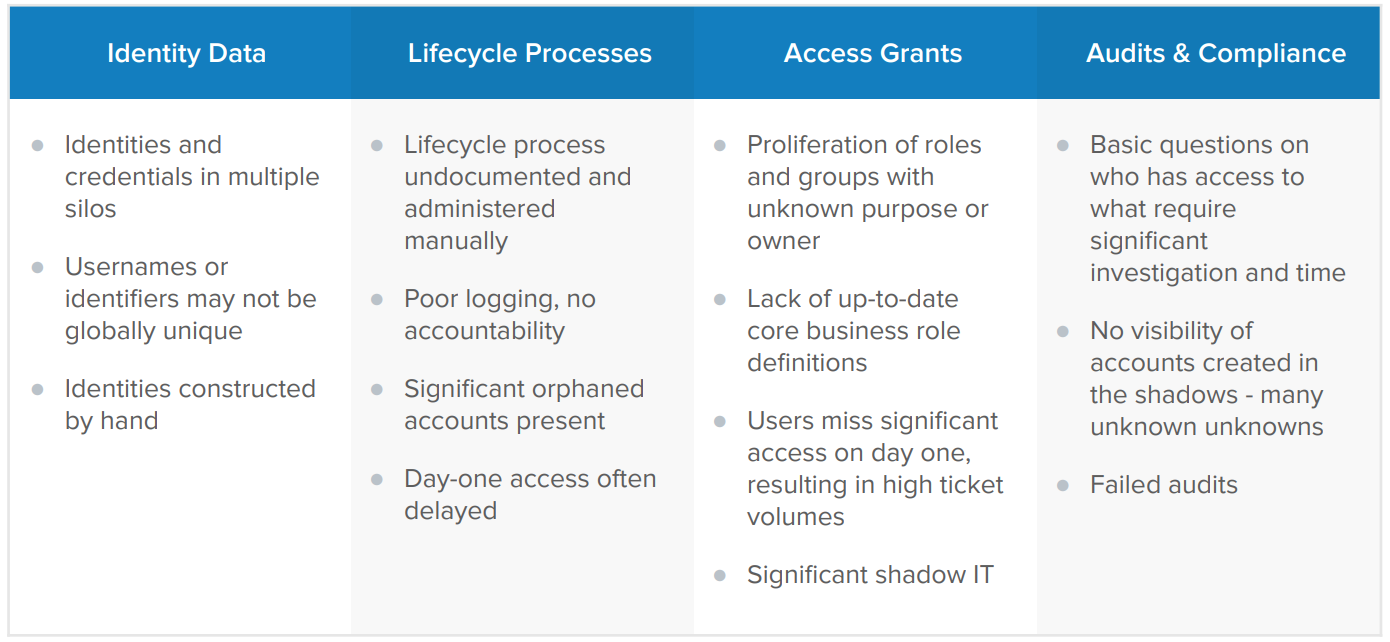
Stage 1 recommendations for managing identity data
During the initial stage of LCM maturity, IT teams handle provisioning and deprovisioning processes manually and waste considerable time on low-value joiner/mover/leaver (JML) “button pushing” tasks.
This is partly because user lifecycle events like hiring aren’t coordinated with IT account creation. As a result, new hires rarely get timely access on their first day of work, and terminated users retain access for too long, creating security risks. If your organization is in this boat, you most likely have minimal documentation or accountability.
Stage 1 recommendations for managing identity lifecycle processes
If you’re constantly putting out fires related to access grants, it’s impossible to meet the expectation of day-one account readiness for new employees. At this stage, business roles are often poorly defined, not updated, or not followed, leading to incorrect or delayed access. Instead, you find yourself scrambling to create ad hoc roles and groups, which in turn creates a mess of objects whose purpose eventually gets forgotten. After day one, if users request additional resources that IT can’t adequately provide, they tend to procure apps or tools on their own—perpetuating shadow IT.
Stage 1 recommendations for managing access grants
Each area of identity management influences how painful your audits are. In stage one, since the IT team is manually provisioning all your resources, you have no central record or logs. Additionally, widespread shadow IT means that every audit requires painstaking investigation, and failed audits are all too common.
Stage 1 recommendations for managing audits & compliance
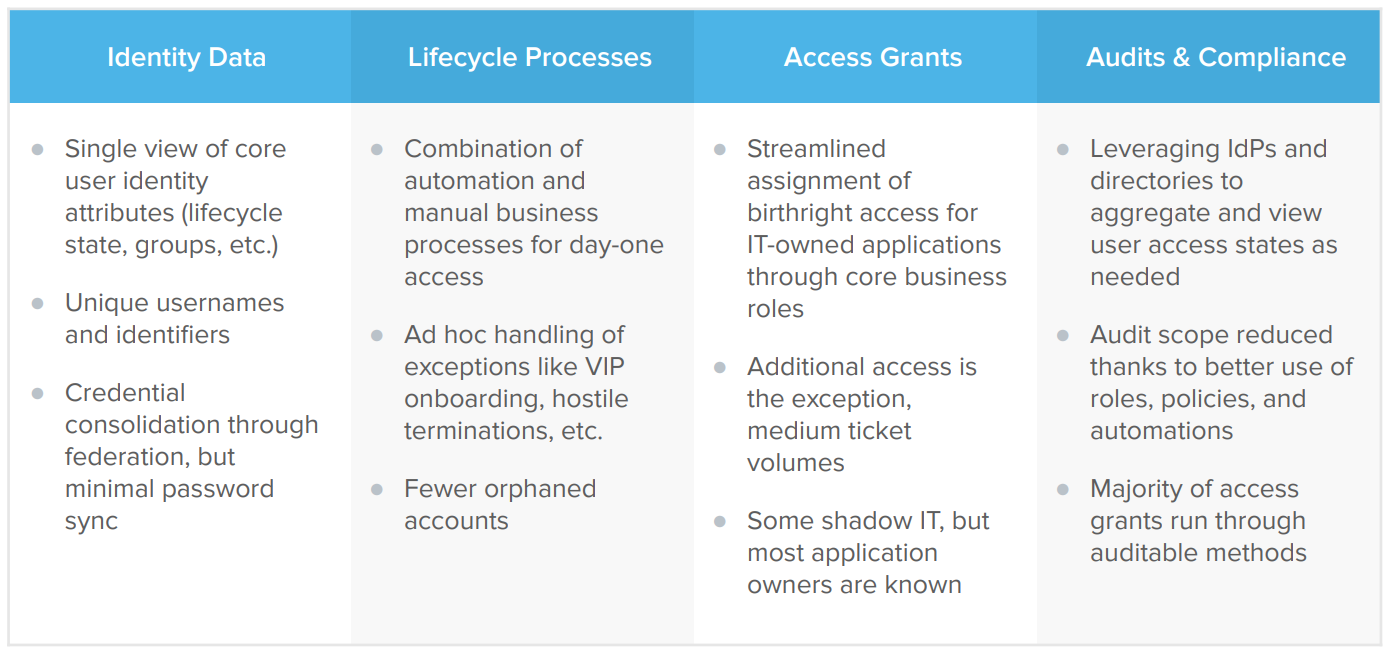
At the second stage of LCM maturity, IT teams are just starting to implement automation, and still rely on many manual processes. If you’re in this camp, automating account creation and updates from your IT-owned system of record is a great way to get a quick IT win, as it doesn’t require lengthy coordination with other departments. As you automate provisioning or deprovisioning for birthright apps that all employees need, like email and storage, you’ll accelerate your time-to-value.
Stage 2 recommendations for managing identity data
Stage 2 recommendations for managing identity lifecycle processes
As you get a better picture of your access grant landscape, your IT team can shift gears towards working with other departments to define (or redefine) their core business role definitions. IT then uses roles to systematically grant access with rigor, improving the organization’s security posture. Users will value the IT team and request additional access by following prescribed practices, reducing Shadow IT. In stage two, IT can facilitate audits by providing lists of users, groups, and associated roles.
Stage 2 recommendations for managing access grants
Stage 2 recommendations for managing audits & compliance
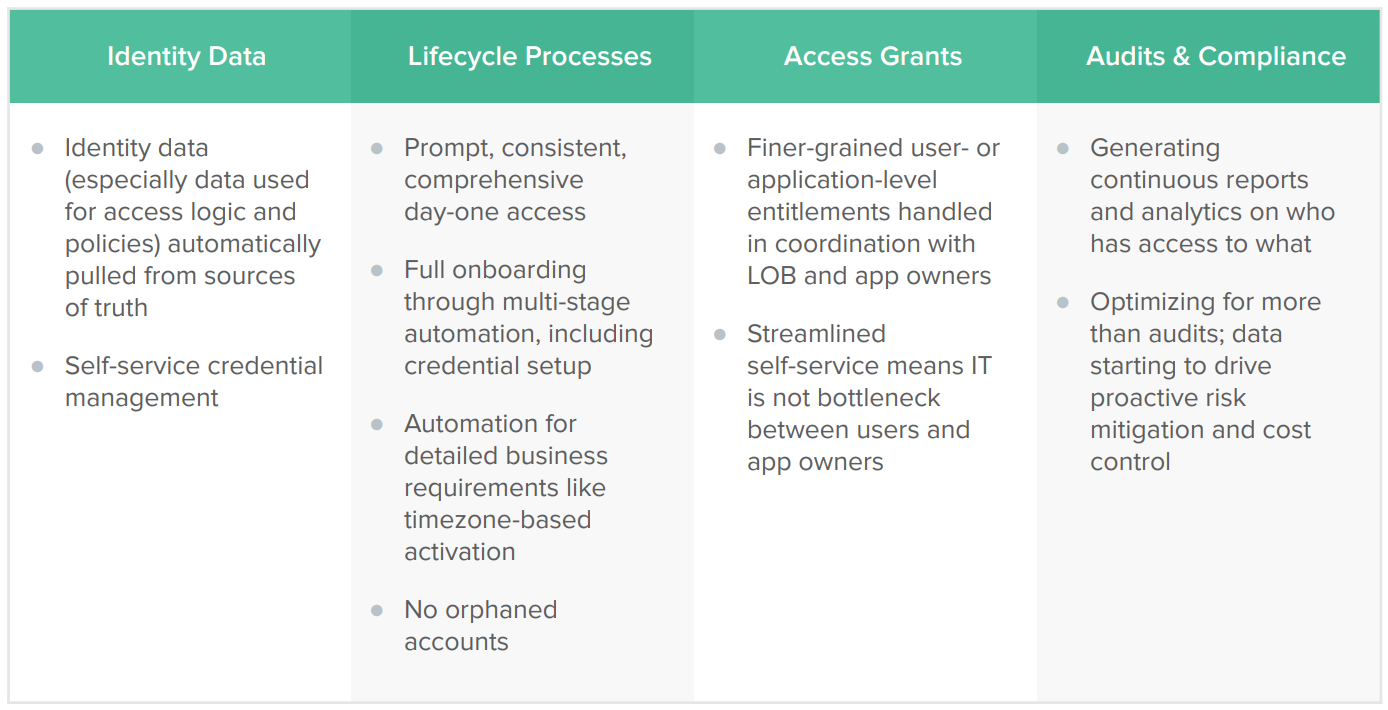
In the next phase, leading IT teams integrate their identity data (email address and phone numbers) with HR sources (personnel data and lifecycle events like hiring and terminating), enabling deeper automation that benefits from faster lifecycle signals. These best practices can power more nuanced identity workflows, such as changing access grants due to parental leave, staging accounts before an employee’s start date, granting alumni access to specific resources, and automating leaver processes for both employees and external users.
Stage 3 recommendations for managing identity data
Stage 3 recommendations for managing identity lifecycle processes
All of these LCM strategies deliver substantial productivity improvements, empower LOB stakeholders, and extend self-service for end users so they can get appropriate apps without IT intervention. You’ll have reliable onboarding and offboarding processes in place for all user types, which helps with audits. And by elevating the efficacy of your audit efforts, you’ll reduce both risks and costs.
Stage 3 recommendations for managing access grants
Stage 3 recommendations for managing audits & compliance
Stage 4: Visionary Automation
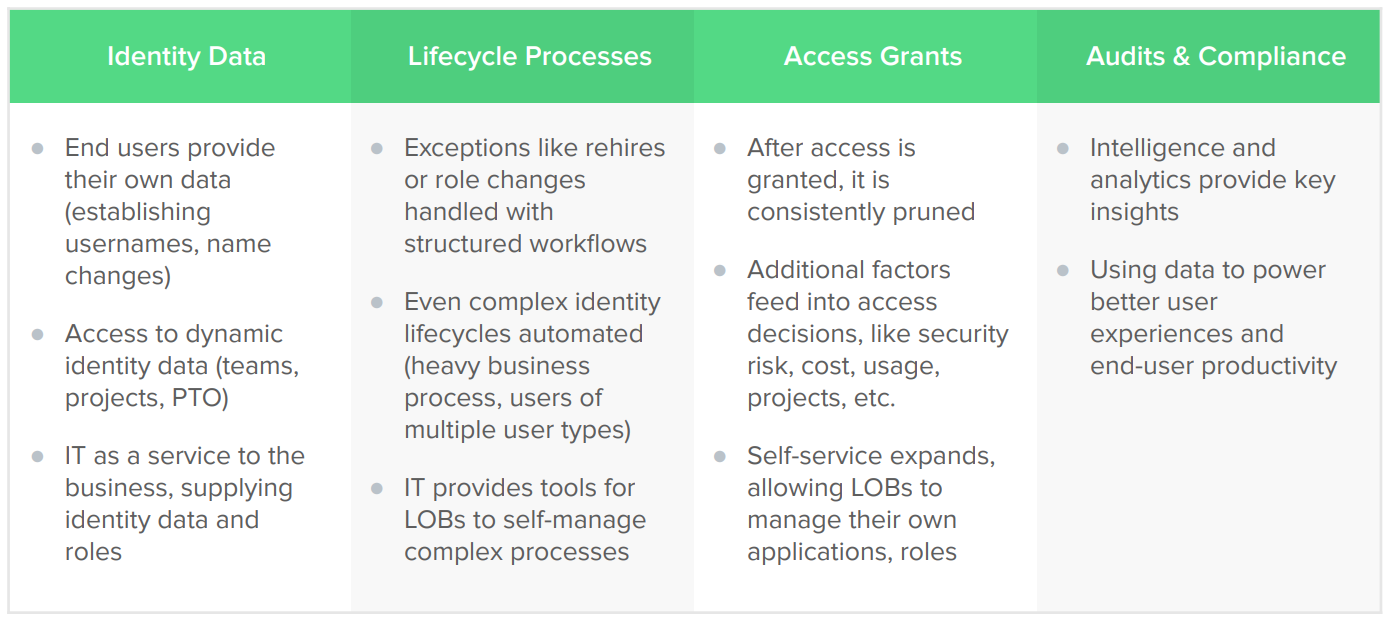
Finally, IT teams that fully optimize their identity processes and aggregate all required data are freed up to better serve the needs of other departments, perhaps by automating certain LOB or geo-specific tasks or by enabling them to build workflows themselves. As a result, you can better adapt to evolving workplace dynamics—rehires, role changes, remote and contract work—that require more complex, but flexible, approaches, like time-based or project-based access. In the visionary automation stage, you’ll see the most efficiency gains from automating these intricate processes.
Stage 4 recommendations for managing identity data
Stage 4 recommendations for managing identity lifecycle processes
Organizations with a visionary approach to granting access will see the greatest improvement to their security posture by incorporating additional insights into access decisions and systematically pruning and purging not just orphaned accounts, but all stale roles, entitlements, and groups. At this level of LCM maturity, LOB stakeholders can benefit from shared identity data to manage their own applications and roles.
Stage 4 recommendations for managing access grants
Stage 4 recommendations for managing audits & compliance
Each organization has its own unique lifecycle requirements and priorities, so you should adapt our identity recommendations to the strategies and techniques that best fit your needs. No matter how you deploy Okta’s end-to-end suite for modern identity management, you’ll be able to ensure day-one access for employees and prevent former users from retaining business accounts—improving productivity and enhancing security.
In particular, Okta’s cloud-based identity and access management solution removes roadblocks to onboarding and offboarding by integrating employee information from IT systems (including Active Directory), as well as the most popular HR applications (Workday, SuccessFactors, UltiPro, BambooHR, and Namely). With Okta’s Universal Directory, organizations can centralize accounts from all of these data stores and establish one identifier per employee. Okta Lifecycle Management (LCM) enables IT teams to simply click a checkbox and orchestrate repetitive identity tasks, such as creating, updating, or deactivating accounts, configuring policies, and reporting on access levels across your ever-shifting workforce and their devices. To learn more, visit okta.com/products/lifecycle-management.
Okta is the leading independent provider of identity for the enterprise. The Okta Identity Cloud enables organizations to securely connect the right people to the right technologies at the right time. With over 6,500 pre-built integrations to applications and infrastructure providers, Okta customers can easily and securely use the best technologies for their business. Over 8,400 organizations, including JetBlue, Nordstrom, Slack, Teach for America and Twilio, trust Okta to help protect the identities of their workforces and customers


